

What is Aviator?
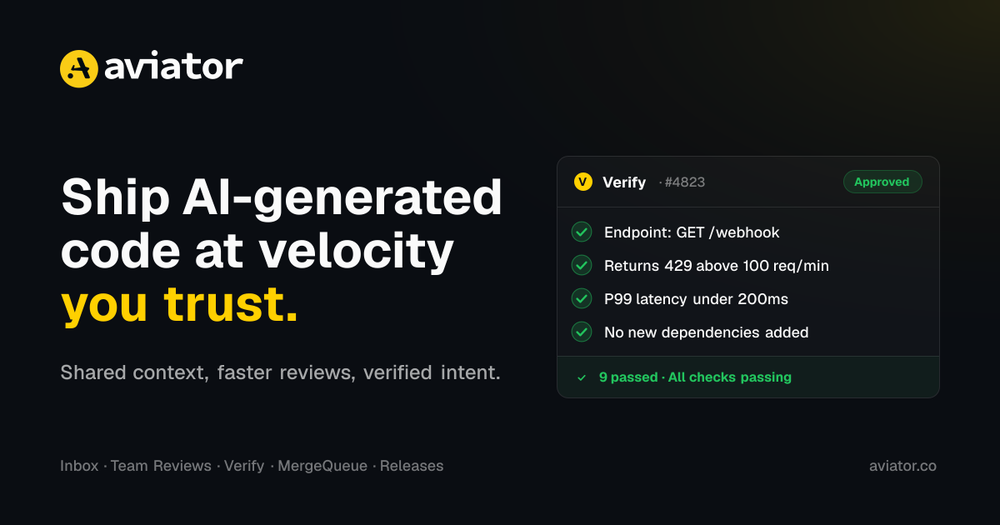
Aviator is a code review and merge automation platform that verifies AI-generated pull requests against defined acceptance criteria and team invariants before merging and deploying them. Aviator differentiates itself by replacing line-by-line review with deterministic verification of intent, so engineering teams can ship AI-produced code at high volume without breaking the main branch.
Key Features
- Verify: Aviator checks every pull request deterministically against its acceptance criteria and team-defined invariants, producing auditable evidence. Each criterion and invariant is marked as passing or failing, and failures cite the specific location, such as a network call made without a timeout in a named file and line.
- Intent-based review: Instead of reviewing every line, reviewers see the stated intent of a PR alongside verification results, so their time goes to decisions and trade-offs rather than mechanical checks.
- Inbox: A single cross-repository queue of every PR waiting on a reviewer, sorted by what to do next, including quick fixes, PRs that block others, and re-reviews after new commits. PRs are grouped by state such as requested review, returned, approved, waiting on others, and queued.
- Team Reviews: Assigns reviewers by code ownership, expertise, and current review load, with suggested reviewers ranked by expertise in the changed files and current review load. It also tracks time to first review against the team's SLO.
- Decision capture: Aviator records user decisions and reviewer arguments on open questions, building team knowledge that persists beyond a single PR.
- Merge-to-deploy automation: Aviator merges and deploys verified PRs without breaking main, at the volume AI agents produce.
- Conflict and change tracking: The review queue surfaces PRs with merge conflicts and flags new changes pushed after a review, so re-reviews are routed correctly.
Use Cases
- Teams shipping AI-generated code: Engineering teams using coding agents to open large volumes of PRs use Aviator to verify each change against acceptance criteria before it reaches main.
- Review triage across repositories: Reviewers use the Inbox to see all PRs waiting on them across repos and prioritize quick fixes and PRs that block other work.
- Reviewer assignment at scale: Teams with clear code ownership use Team Reviews to route PRs to the right owners and measure time to first review against an SLO.
- Enforcing engineering invariants: Teams codify rules such as network calls setting a timeout, no hardcoded secrets, structured logs on exceptions, and backward-compatible migrations, and have Aviator check every PR against them.
- Reducing review latency: Organizations tracking review SLOs use Aviator's reporting, such as the share of first reviews inside SLO over the last 30 days, to manage review performance.
Who It Is For
Aviator targets engineering teams, from startups to Fortune 500s, that review and merge code at high volume, particularly teams adopting AI coding agents that generate more pull requests than manual review can absorb. It fits reviewers, tech leads, and platform teams who need to keep main stable while spending review time on intent and trade-offs rather than line-by-line inspection.
Pricing
The source material does not state Aviator's pricing model, tiers, or whether a free tier or trial is available.
Frequently Asked Questions
What is Aviator used for?
Aviator is used to review, verify, merge, and deploy pull requests, especially AI-generated ones. It checks each PR against acceptance criteria and team invariants, routes it to the right reviewer, and automates merge and deploy so main stays stable.
How does Aviator verify AI-generated code?
Aviator runs deterministic verification against each PR's stated intent, acceptance criteria, and team invariants, and shows auditable evidence for each check. For example, it can flag a failing invariant when a network call is made without a timeout and point to the exact file and line.
How does Aviator assign reviewers?
Aviator's Team Reviews feature assigns reviewers by code ownership, expertise, and current review load. It presents suggested reviewers ranked by expertise in the changed files and current load, and tracks time to first review against the team's SLO.
What is the Aviator Inbox?
The Aviator Inbox is a cross-repository queue of every PR waiting on a reviewer, sorted by what to do next. It groups PRs into requested review, returned, approved, waiting on others, and queued, and surfaces quick fixes, blocking PRs, and re-reviews after new commits.
Who should use Aviator?
Aviator is intended for engineering teams that produce more pull requests than manual review can handle, particularly teams using AI coding agents. It suits reviewers and platform teams that need to enforce invariants and keep main stable while shipping at high velocity.