

What is ClickHouse?
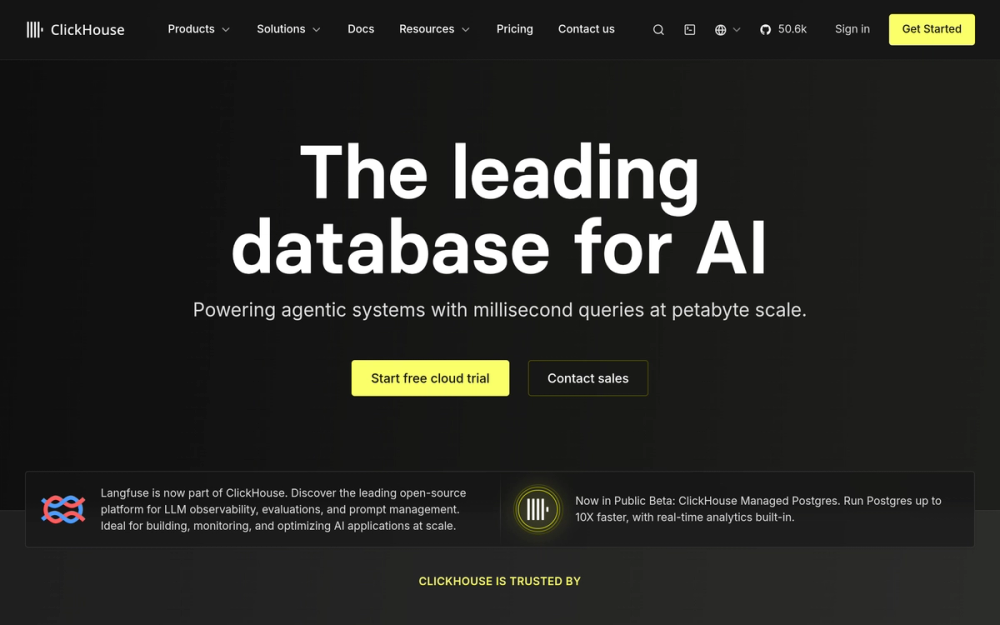
ClickHouse is an open source column-oriented database built for real-time analytics on large data sets. It is made by ClickHouse and is available as self-hosted software and as ClickHouse Cloud, a managed service. The problem it solves is analytical query speed: teams can ingest events continuously and run aggregations over billions of rows without moving data into a separate warehouse.
Key features
- Column-oriented storage. Data is stored by column and compressed, which reduces the data read by analytical queries.
- Real-time ingestion. Events and logs can be queried soon after they arrive, without a batch loading window.
- SQL interface. Analysts and applications use SQL for joins, aggregations, window functions and materialised views.
- Separation of compute and storage. ClickHouse Cloud scales compute and storage independently and can scale idle compute to zero.
- ClickPipes. Managed ingestion connectors stream data from sources such as Kafka and object storage.
- ClickStack. An observability stack built on ClickHouse handles logs, metrics and traces with the same query engine.
- Managed Postgres. ClickHouse Cloud for Postgres runs Postgres instances alongside the analytical database.
Who is ClickHouse for?
Data and platform teams running event analytics, log analysis, observability or product telemetry at high volume. It suits companies that have outgrown row-oriented databases for reporting, teams building real-time dashboards, and organisations that want an open source analytical store they can self-host or buy as a managed service.
Use cases
- Analysing clickstream, product and event data in real time.
- Storing and querying application logs and observability telemetry.
- Building customer-facing analytics dashboards over large data sets.
- Running aggregations for billing, fraud detection or usage reporting.
- Serving as the analytical layer behind an AI or data application.
Pricing
ClickHouse open source is free to self-host. ClickHouse Cloud starts with $300 in credits for 30 days with no credit card required, then moves to usage-based billing with Basic, Scale and Enterprise plans. Compute is billed per compute-unit-hour, where one unit is 8 GiB of RAM and 2 vCPU, and storage is billed per TB per month. For example, the AWS us-east-1 Enterprise rate is $0.39030 per compute-unit-hour and $25.30 per TB per month. Backups, ClickPipes and data transfer are billed separately, and idle compute can scale to zero. See the official ClickHouse pricing page.
Getting started
- Install the open source server, or create a ClickHouse Cloud account.
- Start the server and connect with the ClickHouse client.
- Create a database and table, then insert or stream data.
- Run a SQL aggregation and connect your dashboard or application.
curl https://clickhouse.com/ | shAlternatives
- Tinybird is a managed real-time analytics platform built on ClickHouse.
- Axiom is a log and event analytics platform for high-volume telemetry.
- Grafana Cloud combines metrics, logs and traces with dashboards and alerts.
FAQ
Is ClickHouse free?
The open source database is free to self-host. ClickHouse Cloud includes $300 in credits for 30 days, then bills usage on Basic, Scale or Enterprise plans.
What is ClickHouse used for?
ClickHouse is used for real-time analytics on large data sets, including event analytics, log analysis, observability, dashboards and usage reporting.
ClickHouse vs a traditional data warehouse?
ClickHouse is a column-oriented database designed for low-latency analytical queries on streaming data. A traditional warehouse often targets batch reporting and broader SQL workloads. Many teams use ClickHouse for real-time dashboards and keep a warehouse for other analytics.
Can ClickHouse scale to zero?
Yes. ClickHouse Cloud separates compute and storage and can scale idle compute down to zero, so teams pay only for active compute while storage remains billed.
Does ClickHouse support Kafka?
Yes. ClickPipes provides managed ingestion from streaming sources such as Kafka, as well as object storage connectors.


