
What is Dagster?
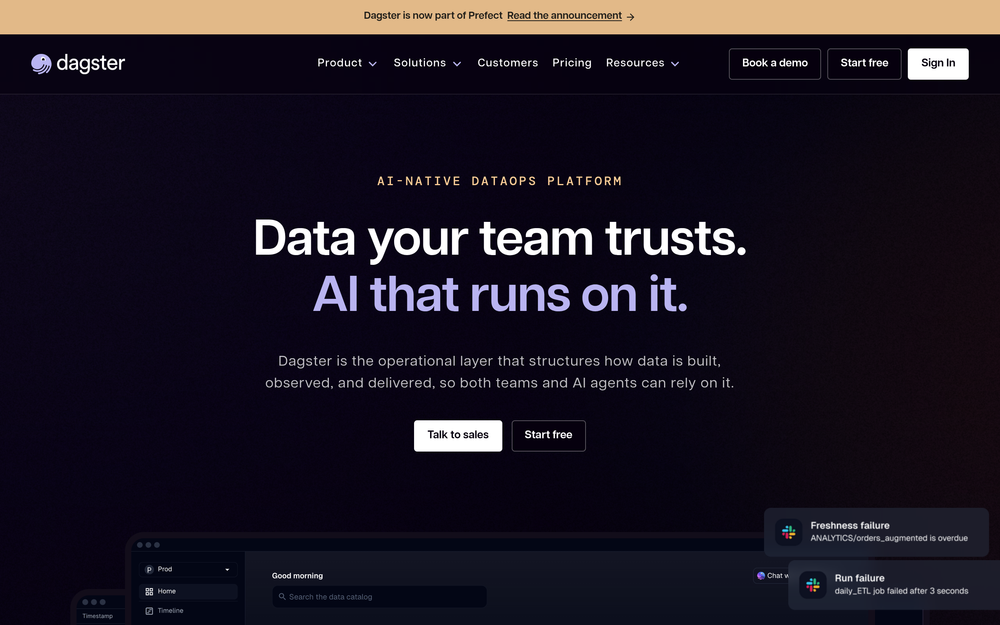
Dagster is a data orchestration platform built around software-defined assets rather than only tasks. It is made by Dagster Labs, which is now part of Prefect, and is available as open source software and as Dagster+, a managed cloud service. The problem it solves is data platform reliability: teams define the tables, models and files they own, then let Dagster schedule, test and track the work that produces them.
Key features
- Asset-based orchestration. Pipelines are modelled as data assets with dependencies, so teams see what exists and what produces it.
- Asset checks and data quality. Checks can validate freshness, schema and custom conditions, with results visible in the catalog.
- Partitions and backfills. Assets can be partitioned by date or category and backfilled when logic or data changes.
- Lineage and catalog. The UI shows asset metadata, ownership, lineage and run history across the platform.
- dbt integration. dbt models and tests can be modelled as Dagster assets, with test results surfaced in the catalog.
- Dagster+. The managed service adds deployments, branch deployments, alerts, role-based access and cost insights.
- AI and MCP. Dagster provides AI chat, proactive monitoring and an MCP server on higher plans, plus skills for coding agents.
Who is Dagster for?
Data platform and analytics engineering teams that want asset-level visibility over ETL and dbt pipelines. It suits companies building a data catalog and lineage alongside orchestration, teams that need data quality checks and backfills, and organisations running machine learning or AI data pipelines. It is also a fit for teams that prefer Python and software engineering practices over configuration-heavy tools.
Use cases
- Orchestrating dbt models with tests and freshness checks.
- Building a data catalog with ownership and lineage.
- Running daily or hourly partitioned pipelines with backfills.
- Monitoring data quality before dashboards refresh.
- Coordinating machine learning feature and training pipelines.
Pricing
Dagster open source is free to self-host. Dagster+ has a Solo plan at $10 per month with one user, one code location and one deployment, plus $0.040 per credit and serverless compute at $0.010 per minute. Starter costs $100 per month with up to three users, five code locations, catalog search and the same usage rates. Pro pricing is custom and adds unlimited code locations and deployments, cost insights, SSO, audit logs and support. A 30-day free trial is available. See the official Dagster pricing page.
Getting started
- Install Dagster and the web server in a Python environment.
- Create a project and define your first asset.
- Start the development server and open the Dagster UI.
- Materialize the asset, then add schedules, checks and partitions.
pip install dagster dagster-webserver
dagster devAlternatives
- Prefect is a Python workflow orchestration platform.
- Apache Airflow is an open source workflow scheduler built on DAGs.
- Temporal is a durable execution platform for long-running workflows.
FAQ
Is Dagster free?
The open source version is free to self-host. Dagster+ plans start at $10 per month for Solo and $100 per month for Starter, with a 30-day free trial.
What is Dagster used for?
Dagster is used to orchestrate data pipelines and track the assets they produce. Teams use it for dbt models, ETL, data quality checks, backfills and machine learning pipelines.
Dagster vs Airflow?
Airflow organises work as task-based DAGs and has a large operator ecosystem. Dagster organises work around data assets and adds a catalog, asset checks and lineage. The choice depends on whether you want task-centric scheduling or asset-centric data ownership.
Is Dagster part of Prefect?
Yes. Dagster's website states that Dagster is now part of Prefect. The Dagster product and Dagster+ service continue to be offered.
Can Dagster run dbt?
Yes. Dagster integrates with dbt so models and tests can be represented as assets, with test results and lineage visible in the Dagster UI.


