

What is Electric?
Electric is a data platform that provides sync primitives and infrastructure for building collaborative, multi-agent systems. It combines Postgres sync, durable streams, TanStack DB integration and PGlite to let developers deploy long-running agents as durable, synced entities without vendor lock-in.
Key features
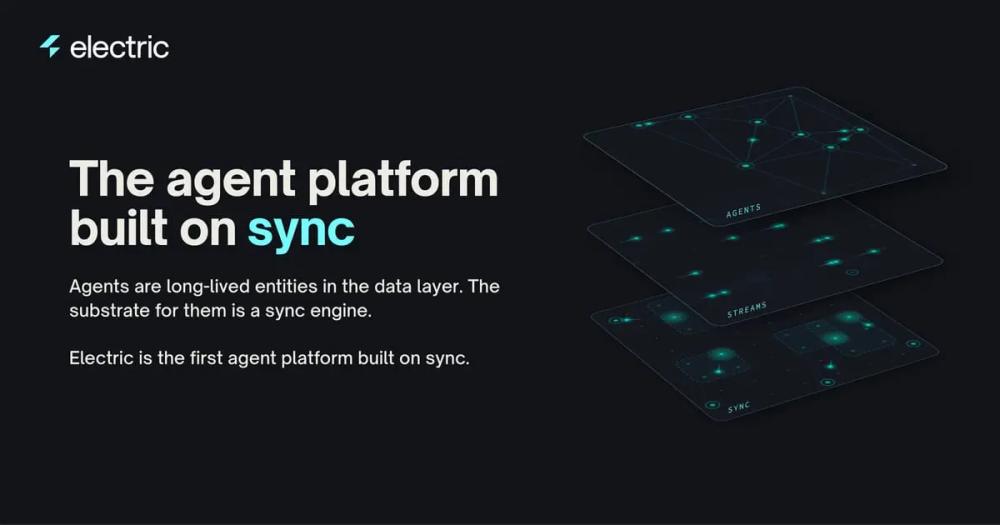
- Electric Agents: A runtime for long-lived agents that live as durable, synced entities, resumable across devices, observable across teams, and forkable for review and experimentation. Agents can scale to zero and be deployed as managed agents without lock-in.
- Electric Streams: Persistent, addressable, real-time streams positioned as a flexible data primitive for agent session data and the agent loop. Streams are append-only and delivered over HTTP.
- Electric Sync: The core sync engine, offering composable sync primitives for end-to-end reactivity and collaboration in multi-agent systems. It syncs from Postgres in real time and is an open protocol under Apache 2.0 built on plain HTTP.
- TanStack DB integration: Live queries via
useLiveQuerylet frontends read synced collections reactively, as shown in the source's Todos example filtering completed items. - Multi-agent collaboration: Supports multi-user, multi-agent systems with humans in the loop, including session sharing where one client can drop, reconnect and catch up while others continue.
- Stack-agnostic delivery: Works next to an existing API and database with any web framework and any client that speaks HTTP and JSON; auth stays with your API and writes go through your backend.
- Electric Cloud: A fully managed, globally distributed data delivery network with usage-based pricing. Streams over plain HTTP let standard CDNs fan out delivery without touching the database, with the source citing 1M+ concurrent readers, a 99% CDN cache hit rate and flat database load.
- PGlite: Listed among Electric's data primitives alongside Postgres Sync, Durable Streams and TanStack DB.
Who is it for?
Electric targets developers and teams building AI agent products and collaborative applications: frontend and full-stack engineers working with React, React Native, Expo or other HTTP-capable clients, and platform teams that need durable agent runtimes and real-time data sync on top of Postgres. It addresses the data-wiring problem behind multi-agent systems, where agents, users and devices need shared, resumable state without rebuilding sync infrastructure or locking into a proprietary backend.
Use cases
- AI agent platforms: Deploy long-running, durable agents that scale to zero and integrate AI coworkers into existing teams, tools and systems.
- Agent session data: Use Streams as the data primitive for agent loops, including streaming text deltas such as
{"type":"text-delta","delta":"Hi, "}over HTTP. - Collaborative review workflows: Fork agent entities for review and experimentation, and share a session URL across multiple clients where disconnected users catch up on reconnect.
- Real-time Postgres-backed apps: Sync data from Postgres in real time and render it with live queries in React or React Native/Expo clients.
- High-scale data delivery: Serve high-throughput data to large audiences through CDNs while database load stays flat, per the source's benchmarks.
Pricing
Electric offers a hosted, usage-based, turnkey option through Electric Cloud, with pricing details available on its pricing page. The source does not list specific price figures or state whether a free tier or trial exists.
What's new and trending
The source announces that Electric is joining Neon at Databricks, and the homepage frames the product around agents on sync, with Agents, Streams and Sync presented as its three core pillars. No version numbers or release dates are documented in the source.
Getting started
Developers can start via the Get started and Quickstart paths on the site, or read the documentation, which includes an /llms.txt file with optimized Markdown documentation for LLMs. Electric can be dropped in next to an existing API and database, and a fully managed deployment is available through Electric Cloud.
Alternatives
The source does not name any alternatives to Electric.
FAQ
What is Electric used for? Electric is a data platform for building collaborative, multi-agent systems, providing Postgres sync, durable streams, a long-lived agent runtime and TanStack DB integration so agents and users share synced, resumable state.
Is Electric free? The source does not state that Electric is free. It describes Electric Cloud as hosted with usage-based pricing and points to a pricing page, but lists no specific prices or free tier.
Does Electric work with my existing stack? Electric is designed to sit next to an existing API and database and works with any web framework and any client that speaks HTTP and JSON, with authentication handled by your API and writes routed through your backend.
How does Electric handle scale? Electric streams data over plain HTTP, so standard CDNs can fan out delivery without touching the database; the source cites 1M+ concurrent readers, a 99% CDN cache hit rate and database load that stays flat.
Is Electric open source? Electric Sync is described as an open protocol under Apache 2.0 built on just HTTP, with no siloes or black boxes.


