

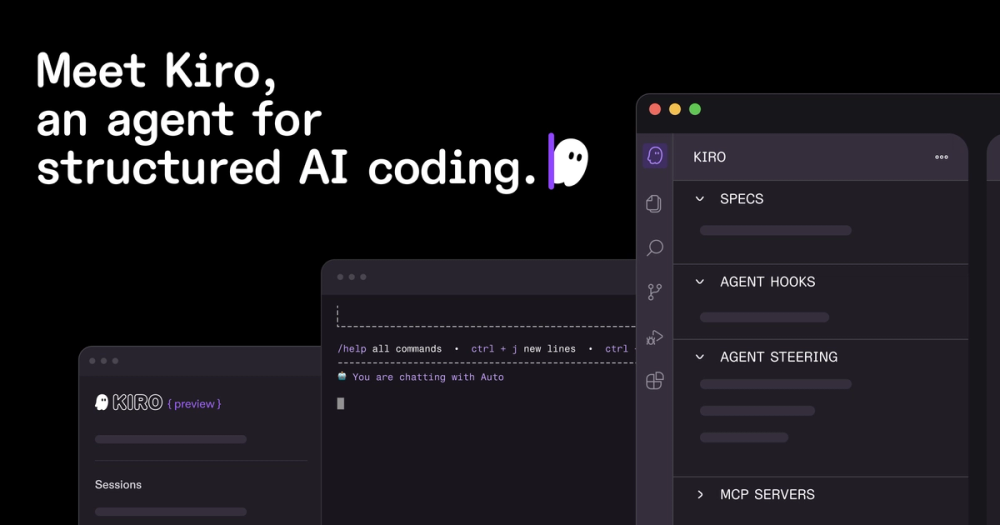
What is Kiro?
Kiro is an agentic coding platform built by AWS. Its main idea is spec-driven development: instead of jumping straight from a prompt to code, Kiro turns your request into structured requirements, a technical design and a sequenced list of tasks, then has agents implement those tasks. This gives teams a clearer, reviewable plan and helps keep AI-generated code aligned with what was intended. Kiro is available as an IDE, a CLI and on the web.
Key features
- Specs: generate requirements, design documents and implementation tasks from a prompt, then build from them.
- Vibe mode: chat with the agent for quick, exploratory changes.
- Agent hooks: trigger agents automatically on events such as saving a file.
- Steering: project rules and context files that guide how the agent works.
- MCP support: connect external tools through the Model Context Protocol.
- Multiple surfaces: Kiro IDE, Kiro CLI, Kiro Web and multi-agent features.
- Model choice: access to several frontier models, with usage billed in credits.
Who is it for?
Kiro is for developers and teams who want more structure from AI coding than chat alone, including those building production systems where requirements, design and traceability matter. It is also a natural fit for teams already on AWS.
Use cases
- Turning feature ideas into specs and implementing them task by task
- Automating repetitive work such as tests and docs with hooks
- Onboarding to an unfamiliar codebase
- Running coding agents from the terminal with the CLI
- Prototyping quickly in vibe mode
Pricing
Kiro offers a free tier and paid plans based on credits, with higher tiers for heavier use. Model credit costs differ by model. See the official Kiro pricing page for current plans.
What's new and trending
On October 23, 2026, Kiro made Claude Haiku 5.5 available with experimental support across the Kiro IDE, CLI, Crew and Web for Pro, Pro+, Pro Max and Power customers, with a 1M-token context window (Kiro changelog).
Getting started
- Download Kiro from kiro.dev and sign in.
- Open a project folder.
- Start a spec by describing a feature, then review the generated requirements and design.
- Let the agent work through the task list, reviewing changes as it goes.
- Add steering files and hooks to match your team's conventions.
Alternatives
Cursor and Google Antigravity are other agent-first IDEs, and GitHub Copilot adds agents to popular editors. For terminal agents, compare Claude Code, Gemini CLI and OpenCode, and for the JetBrains ecosystem see Junie.
FAQ
Who makes Kiro? Kiro is built by AWS.
What is spec-driven development? It is an approach where the agent first writes requirements, a design and tasks, and then implements code based on that plan.
Is Kiro free? Kiro has a free tier, and paid plans add more credits.
Does Kiro have a CLI? Yes. Kiro is available as an IDE, a CLI and on the web.
Does Kiro support MCP? Yes. You can connect MCP servers to give agents access to external tools.


