

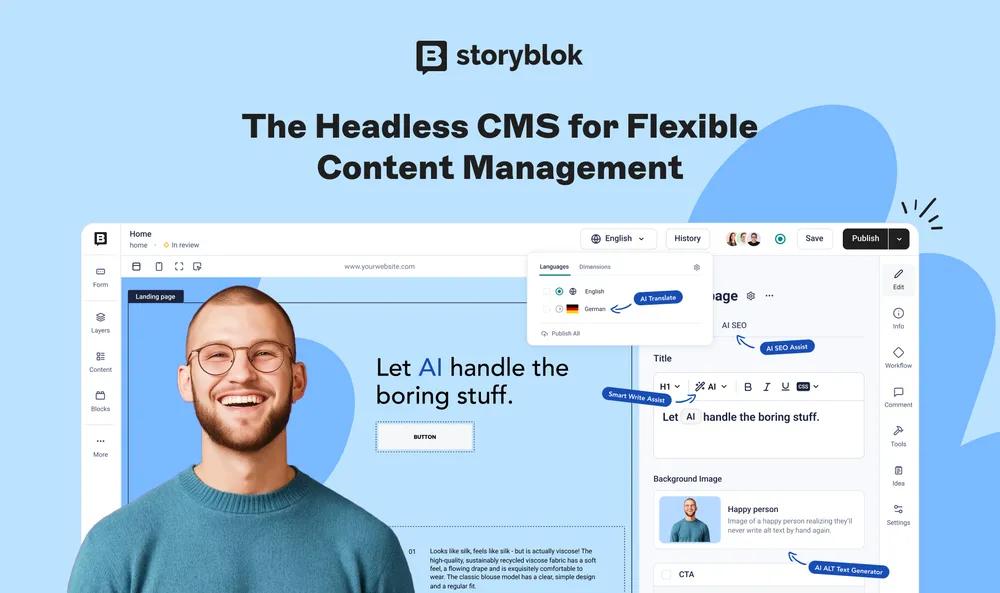
What is Storyblok?
Storyblok is a headless content management system with a visual editor for building content-driven websites and applications. It is made by Storyblok GmbH and combines reusable content components with APIs that deliver content to any frontend. The problem it solves is the gap between marketing editors and developers: editors arrange real components in a visual preview, while developers keep control of the code, design system and deployment.
Key features
- Visual editor. Editors edit content in a live preview of the page and see how components look before publishing.
- Component-based content. Content is modelled as reusable blocks such as heroes, cards and product grids, which map to frontend components.
- Headless APIs. Content is delivered through REST APIs, with GraphQL on higher plans, to frameworks such as Next.js, Nuxt, Astro and React.
- Localisation. Projects can manage multiple locales and translated slugs, with field-level translation workflows on higher plans.
- Workflows and releases. Teams can schedule stories, stage changes in releases and control who publishes what.
- Asset manager. Images and files are stored, optimised and served through Storyblok's image service.
- AI features. Storyblok includes AI credits for content generation, translations and alt text, with more controls on higher plans.
Who is Storyblok for?
Marketing and content teams that need editorial freedom without a developer for every page change, and development teams building sites with modern frontend frameworks. It suits companies running multi-language marketing sites, ecommerce content and large component libraries, as well as agencies that hand editable sites to clients. It is a strong fit when the design system already exists in code and content must map to it.
Use cases
- Running a multi-language marketing site with a visual editor.
- Letting editors assemble landing pages from approved components.
- Delivering product and campaign content to a Next.js storefront.
- Managing a shared component library across several brands or regions.
- Scheduling seasonal content without a deployment.
Pricing
Storyblok has a Starter plan at $0 with one space, one seat, 100 GB of traffic, 100,000 API requests, two locales and 25,000 AI credits. Growth costs $99 per month, or $90.75 billed annually, with five seats, 1 million API requests and 100,000 AI credits. Growth Plus costs $349 per month, or $319.91 billed annually, with 15 seats, 4 million API requests, 10 locales and 200,000 AI credits. Premium and Elite plans are custom and add SSO, environments, approval workflows, A/B testing and higher service levels. See the official Storyblok pricing page.
Getting started
- Create a free Storyblok account and a new space.
- Define the content components your frontend will render.
- Connect a frontend framework and fetch content with the Content Delivery API.
- Invite editors, build a page in the visual editor and publish it.
Alternatives
- Sanity is a headless CMS with structured content and a customisable studio.
- Strapi is an open source headless CMS with a REST and GraphQL API.
- Directus is an open source data platform and headless CMS.
- Payload is an open source headless CMS built for TypeScript applications.
FAQ
Is Storyblok free?
Yes. The Starter plan costs $0 and includes one space, one seat, 100,000 API requests, two locales and 25,000 AI credits. Paid plans start at $99 per month.
What is Storyblok used for?
Storyblok is used to manage and deliver content for websites and applications. Its visual editor lets teams edit components in a live preview, while APIs send the content to any frontend.
Storyblok vs Sanity?
Both are headless CMS platforms with structured content. Storyblok centres on a visual component editor and a block-based content model, while Sanity provides a customisable editing studio and a query language. The better fit depends on how much editorial visual editing you need versus custom studio workflows.
Does Storyblok work with Next.js?
Yes. Storyblok provides guides and SDKs for Next.js, Nuxt, React, Vue, Astro and other frameworks, and content is available through REST and GraphQL APIs.
Can editors publish without developers?
Yes. Editors can create pages from approved components and publish them in the visual editor. Developers keep control of the component code and design system.


