

What is Upstash?
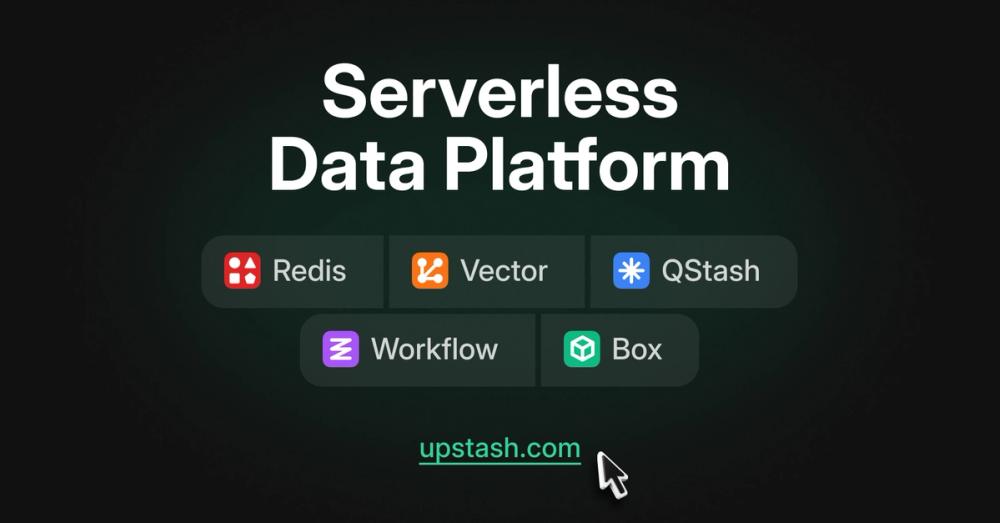
Upstash is a serverless data platform. Its best-known product is a managed, Redis-compatible database, but it also offers a vector database, a message queue and scheduler called QStash, and a durable Workflow product. Every service is accessible over HTTP/REST as well as standard protocols, so it works well in serverless functions and edge runtimes where long-lived TCP connections are a problem. You pay based on usage instead of reserving servers.
Key features
- Upstash Redis: a Redis-compatible key-value store with global replication options and a REST API.
- Upstash Vector: a serverless vector database for embeddings and similarity search.
- QStash: HTTP-based messaging, scheduling and retries for serverless functions.
- Workflow: durable, multi-step workflows built on QStash.
- Rate limiting: the
@upstash/ratelimitlibrary for protecting APIs. - SDKs: TypeScript and Python clients designed for serverless and edge environments.
- Integrations: works with Vercel, Cloudflare Workers, AWS Lambda and more.
Who is it for?
Upstash is for developers building serverless and edge applications who need fast data and messaging without managing infrastructure, and for AI app builders who need a vector store and background jobs. Its pay-per-request model also means small projects and prototypes cost little or nothing while idle, which is a good fit for side projects and apps with spiky traffic.
Use cases
- Caching and session storage for serverless apps
- API rate limiting
- Leaderboards, counters and feature flags in Redis
- Semantic search and RAG with Upstash Vector
- Background jobs, cron schedules and webhooks with QStash and Workflow
Pricing
Upstash has free tiers and pay-as-you-go pricing for each product, with fixed-price and enterprise plans available. See the official Upstash pricing page for current rates.
What's new and trending
On October 26, 2026, Upstash released @upstash/redis 1.40.0 together with version 4.0.0 of its @upstash/search-redis and @upstash/search-ioredis packages (release notes).
Getting started
- Create an account at upstash.com and create a Redis database.
- Copy the REST URL and token from the console.
- Install the client with
npm install @upstash/redis. - Create a client with
Redis.fromEnv()and run commands likesetandget. - Add QStash or Vector as your app grows.
Alternatives
For databases, compare Supabase, Neon and Turso. For vector search, see Pinecone, Qdrant, Weaviate and Chroma. For background jobs and workflows, look at Inngest, Trigger.dev and Temporal.
FAQ
Is Upstash Redis compatible with Redis clients? Yes. It supports the Redis protocol as well as an HTTP/REST API.
Is Upstash free? Each product has a free tier. Beyond that you pay for usage or choose a fixed plan.
Why use Upstash at the edge? Its HTTP-based clients work in runtimes like Cloudflare Workers and Vercel Edge where TCP connections are limited.
What is QStash? QStash is Upstash's HTTP messaging and scheduling service for serverless functions, with retries and delays.
Does Upstash have a vector database? Yes. Upstash Vector stores embeddings and supports similarity search.


