

What is Agno?
Agno is a Python SDK and self-managing agent platform for building, running, and improving AI agents in your own cloud. Its core building blocks are agents, teams, and workflows: use an agent for a focused model-driven program, a team for specialist coordination or delegation, and a workflow for repeatable steps, branching, loops, or parallel execution. Agno is designed for developers who want a practical path from an agent prototype to a durable service rather than a thin prompt wrapper.
Best for
Agno is best for Python teams building customer-facing or internal agents that need more than a single request-and-response loop. The official SDK documentation describes capabilities for sessions, storage, memory, knowledge retrieval, tools, guardrails, human approval, background execution, evaluations, observability, and scheduling. The SDK supports 30+ model providers and 100+ tool integrations according to the official documentation, while its model-agnostic approach is intended to let teams change supported providers without rewriting their agents.
Agno is especially relevant when you want to run the same agents as an API and expose them through an MCP server. AgentOS provides the runtime and service layer around agents, teams, and workflows, including persistence, authorization, tracing, background execution, scheduling, and interfaces. The official site says the platform can serve agents to a product over REST, to ChatGPT and Claude over MCP, and to chat applications such as Slack and Discord through Agno interfaces. Teams that prefer to keep application data in their own cloud and database should evaluate Agno’s deployment templates and operational requirements before committing.
Alternatives
- CrewAI — the closest direct alternative in this set. CrewAI’s official open-source page positions it as a multi-agent platform for defining agents, tasks, and crews, so it overlaps with Agno’s agent-team-workflow use case. The products differ in emphasis: Agno combines a Python SDK with the AgentOS runtime and control plane, while CrewAI centers its own agent, task, and crew orchestration model.
- Langfuse — an adjacent option rather than a replacement for Agno. Langfuse’s official site focuses on tracing, evaluations, prompt management, experiments, cost tracking, and production observability for agents and LLM applications. Choose it when the missing layer is measurement and improvement; it does not present itself as Agno’s full agent runtime.
- LiteLLM — an adjacent infrastructure alternative. LiteLLM’s official documentation describes a gateway and Python SDK for routing requests to 100+ providers, plus keys, budgets, costs, MCP tools, and A2A agents. It can complement an agent framework, but its primary role is model and agent traffic management rather than Agno-style agent orchestration and durable application services.
Pricing
The official Agno homepage and documentation consulted for this draft do not specify a public Agno subscription price or a complete hosted-service price table. The open-source agno-agi/agno repository is published under the Apache-2.0 license. Teams should confirm current costs, hosted AgentOS or Control Plane terms, model-provider charges, infrastructure, and any commercial conditions directly with Agno before planning a production budget. Apache-2.0 licensing for the repository should not be treated as proof that every hosted or commercial service is free.
FAQs
1. What language do I use to build Agno agents?
Agno’s official SDK documentation describes Agno as a Python SDK. You build agents, teams, and workflows in Python, then add models, tools, storage, knowledge, memory, guardrails, and other capabilities as the use case requires.
2. What is the difference between the Agno SDK and AgentOS?
The SDK is the construction layer: it provides the primitives and capabilities used to define agents, teams, and workflows. AgentOS is the runtime and service layer that registers those components and serves them through an API and MCP server, with platform features such as persistence, authorization, tracing, background execution, and scheduling.
3. Can Agno use models from different providers?
Yes. Agno’s official site describes it as model-agnostic, and the SDK documentation lists 30+ providers behind one API. Provider availability and exact model behavior can change, so check the current provider documentation and configure the credentials required by the selected model.
4. Can Agno agents search private documents or retain session context?
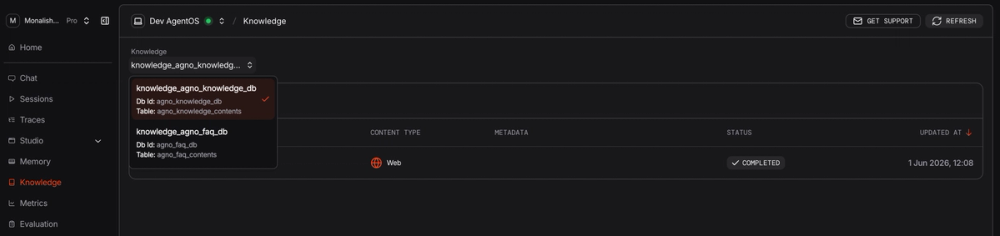
The official SDK documentation lists storage, sessions, memory, and knowledge as supported capability areas. The AgentOS knowledge guide shows knowledge bases managed through the AgentOS interface and documents vector-database, contents-database, and embedder prerequisites. Your database, embedder, permissions, and retrieval configuration still determine what an agent can access.
5. Does Agno support approval and operational monitoring?
The official documentation lists human-in-the-loop controls, evaluations, observability, tracing, and scheduling. AgentOS is documented as handling authentication, role-based access, resume/replay, human approvals, scheduling, and durable execution. Treat these as documented platform capabilities, not a guarantee that every deployment has identical defaults; verify configuration and support boundaries for your environment.