

What is ConfigCat?
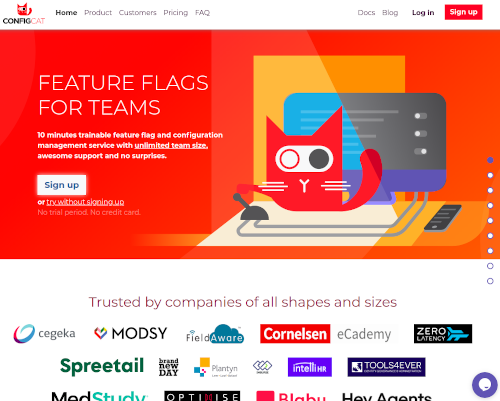
ConfigCat is a hosted feature flag and configuration management service that lets teams turn features on or off after code is deployed. ConfigCat distinguishes itself with unlimited seats, open source SDKs across a broad range of platforms, and a reasonable price tag.
Key Features
- Feature toggles after deployment: ConfigCat lets teams turn features ON/OFF using its Dashboard even after code is deployed, decoupling feature releases from code deployments.
- Targeted user segments: ConfigCat targets user segments based on region, email, subscription, or any other custom user attribute.
- Rollouts, A/B testing and variations: ConfigCat supports percentage rollouts, A/B testing, and variations for controlled feature exposure.
- Open source SDKs: ConfigCat provides open source SDKs with getting started guides and detailed documentation for easy integration into mobile, desktop, website, or backend systems.
- Broad platform coverage: Supported SDKs include JavaScript, Angular, React, Vue.js, Bun, Deno, Node.js, .NET, Java, Go, PHP, Laravel, Python, Ruby, Android, iOS, macOS, Flutter, Kotlin Multiplatform, React Native, Chromium Extension, C++, Rust, Swift, Dart, Elixir, Unity, Unreal Engine, and Cloudflare Worker.
- Integrations: Integrations let teams use feature flags within their existing tools and services.
- Unlimited seats: ConfigCat's feature flag service includes unlimited seats for teams.
Use Cases
- Product managers running experiments: Product managers can configure and launch A/B tests and variations without waiting on engineering releases, as teams at Speechify report doing with ConfigCat.
- Engineering teams shipping safely: Backend and frontend teams can move from no feature flags to heavy usage to facilitate quick and safe deployments, as described by the VP of Engineering at modsy.com.
- Compliance-sensitive organizations: Teams can streamline feature flags and reduce compliance overhead involved in changing flag values, as reported by a platform manager at FieldAware.
- Targeted feature rollouts: Teams can roll out new features to specific user groups, and can plan to use flags to offer different tiered paid-for features, as described by a developer at ControlPoint.
- Small teams evaluating feature flags: Smaller companies can try the free feature set in a real environment and later move to the Professional tier, as described by a senior web developer at medstudy.com.
Who It Is For
ConfigCat is aimed at product teams, software developers, and engineering organizations that want to separate feature releases from code deployments. It suits teams working across web, mobile, desktop, and backend systems, since its open source SDKs cover a wide range of languages and frameworks. Product managers benefit from being able to configure and launch tests directly, while engineering and platform teams use ConfigCat to control critical changes, target specific user groups, and reduce the overhead of changing flag values.
Pricing
ConfigCat offers a Forever Free plan that requires no credit card, alongside paid tiers; the source references a Professional tier but does not quote specific prices. The service is positioned as having a reasonable price tag with unlimited seats.
Frequently Asked Questions
What is ConfigCat used for?
ConfigCat is a hosted feature flag and configuration management service. It lets teams turn features on or off after deployment, target user segments, run percentage rollouts and A/B tests, and manage configuration without redeploying code.
Is ConfigCat free?
ConfigCat offers a Forever Free plan that requires no credit card. Paid tiers exist, including a Professional tier, but specific prices are not stated in the source material.
Which platforms and languages does ConfigCat support?
ConfigCat provides open source SDKs for a wide range of platforms, including JavaScript, React, Angular, Vue.js, Node.js, .NET, Java, Go, PHP, Laravel, Python, Ruby, Android, iOS, macOS, Flutter, React Native, Kotlin Multiplatform, C++, Rust, Swift, Dart, Elixir, Unity, Unreal Engine, and Cloudflare Worker.
How does ConfigCat target specific users?
ConfigCat lets teams target user segments based on region, email, subscription, or any other custom user attribute. It also supports percentage rollouts, A/B testing, and variations.
Who should use ConfigCat?
ConfigCat suits product managers, developers, and engineering teams that want to decouple feature releases from code deployments. It is used by teams of all shapes and sizes, from small companies trying the free plan to organizations controlling critical changes with feature flags.


