

What is DSPy?
DSPy is an open-source Python framework for programming language-model systems rather than hand-writing brittle prompts. You describe a task with structured signatures, compose reusable modules in Python, and use optimizers to improve prompts or model weights against a metric. The result is a program that can be revised as your data, control flow, or language model changes. The official site describes DSPy as a framework for building maintainable, modular, and optimizable AI programs, while the repository expands that idea to classifiers, RAG pipelines, and agent loops.
Best for
DSPy is a strong fit for developers, ML engineers, and NLP researchers who need a repeatable way to build multi-step LLM workflows. It is especially useful when quality depends on more than one completion: retrieval, decomposition, tool use, structured extraction, evaluation, or a sequence of modules. Instead of keeping a long prompt synchronized with every pipeline change, you define typed inputs and outputs with a Signature and select a Module such as Predict, ChainOfThought, or ReAct. An Optimizer can then compile the program using examples and a scoring metric.
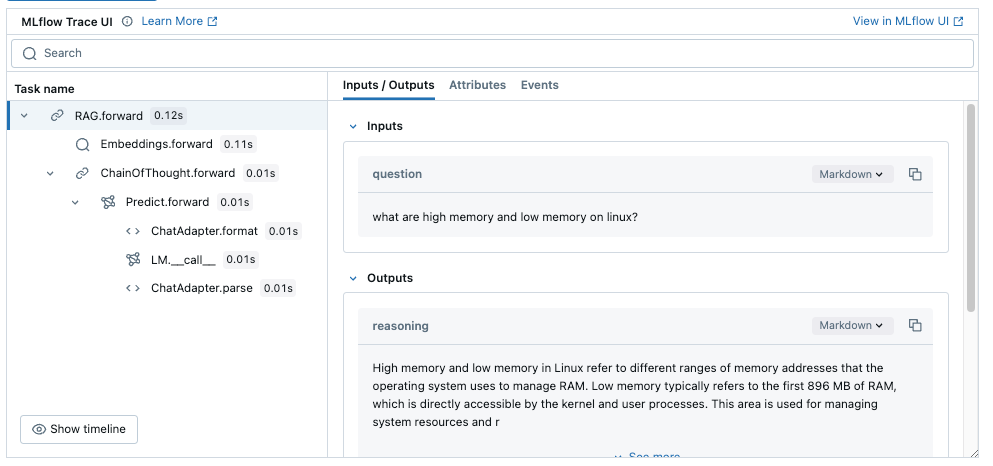
The framework is practical for RAG experiments and production-oriented prototypes. The official RAG tutorial walks through a question-answering system, a retriever, evaluation, optimization, cost tracking, and saving a compiled program. DSPy also documents multimodal Signatures, including image fields, and tool-using programs. You still need to write Python, supply model access, design useful metrics, and evaluate results; DSPy is not a no-code application builder or a hosted model provider.
Alternatives
- LlamaIndex is a broader application and data framework for connecting documents, parsing, indexing, retrieval, and agents. It is a direct alternative when the main job is document-centric RAG, but DSPy is more focused on programming and optimizing the behavior of an LM pipeline.
- LangSmith is an adjacent option for tracing, evaluation, deployment, and monitoring agent systems. It complements DSPy more naturally than it replaces DSPy’s Signature, Module, and optimizer abstractions.
- Langfuse is an open-source observability and evaluation platform for traces, prompts, experiments, and cost/latency analysis. It is useful alongside DSPy when the priority is production visibility rather than program compilation.
Pricing
The official DSPy site presents the framework as MIT licensed and installable with pip install -U dspy. It does not publish a DSPy subscription price because DSPy is software you run in your own Python environment. Your total operating cost can still include the language-model provider, embeddings, vector or retrieval infrastructure, and additional model calls used during optimization. DSPy’s FAQ gives an example of compilation overhead, but that historical example is not a current price quote. Confirm provider pricing separately before budgeting.
FAQs
1. What is the smallest useful DSPy program?
Start with a Signature that states the input and output fields, then pass it to a Module such as dspy.Predict. The official examples show a short Python program that defines a task, configures an LM, calls the module, and receives a structured Prediction. You can add modules and control flow as the task grows.
2. Does DSPy replace prompt engineering completely?
No. DSPy moves much of the prompt construction and iteration into program abstractions and optimizers, but you still define the task, examples, metric, and pipeline. The framework can generate or refine instructions and demonstrations; it does not remove the need to decide what “good” means or to test quality on representative data.
3. Which models can DSPy connect to?
The installation guide uses dspy.LM with a provider/model string and explains that DSPy normalizes many inference providers through LiteLLM. The exact available models and provider requirements can change, so check the current provider documentation and supply the relevant API credentials. DSPy itself does not provide model inference for free.
4. Can DSPy build a RAG system?
Yes. The official RAG tutorial builds a question-answering program with a retriever, examples, evaluation, and an optimizer. DSPy does not require one particular search backend: the tutorial shows Python code for embeddings and retrieval, and the FAQ says you can integrate open-source retrieval libraries. You remain responsible for corpus quality, access controls, and retrieval evaluation.
5. What does an optimizer actually change?
An optimizer compiles a DSPy program against a metric. Depending on the optimizer, it may propose instructions, bootstrap few-shot examples, improve intermediate prompts, fine-tune weights, or combine strategies. Compilation requires additional LM calls and can cost money. Save the resulting compiled program and record its model, data, metric, and optimizer settings if you need reproducible comparisons.