

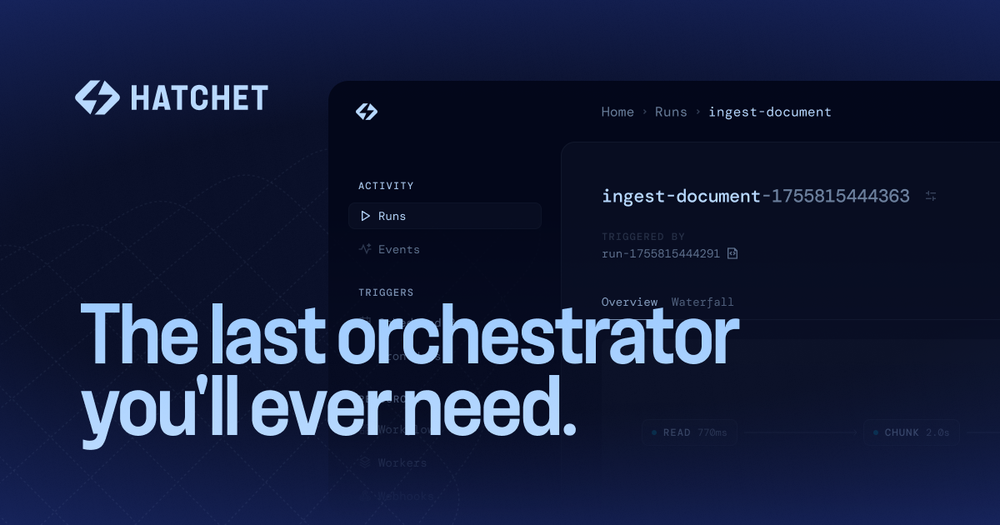
What is Hatchet?
Hatchet is an orchestration engine that runs AI agents, background tasks, and mission-critical workflows on a single platform. It persists the history of every task and state transition, enabling automatic retries, manual replays, and debugging across distributed systems.
Key features
- Background tasks: Tasks are defined as simple functions, giving developers a lightweight way to offload work from the main application.
- Retries: Flexible, configurable retry policies include exponential backoff for handling transient failures.
- Scheduled tasks and cron jobs: Tasks can be scheduled for a specific time in the future or run on a regular cron schedule.
- Task routing: Routing supports strict conditions such as worker labels, plus more complex weighted scheduling rules using worker affinity.
- Event and webhook triggers: Event triggers and listeners support event-driven, highly distributed systems, and webhook triggers connect Hatchet tasks to upstream data sources.
- Durable tasks: Fault-tolerant, long-running workflows recover from failure, with complex conditions for pause/resume using durable sleep, event waits, or a combination of both.
- DAGs: Directed acyclic graphs support data pipelines and simple workflows, with guidance available on choosing between durable tasks and DAGs.
- Scale controls: Priorities let critical tasks run ahead of non-latency-sensitive work like backfill jobs; rate limits can be configured statically for third-party APIs or dynamically for per-user limits; fair scheduling uses concurrency policies; and global deployments span the US and EU.
Who is it for?
Hatchet targets engineering teams building reliable, distributed applications: teams running AI agents, background job systems, and mission-critical workflows that need durability and observability. It addresses the problem of tasks failing silently or being hard to debug by storing every task and state transition, so failures can be retried automatically, replayed manually, or investigated through traces and logs.
Use cases
- AI agent orchestration: Teams running AI agents as long-running, fault-tolerant workflows that must recover from failure mid-run.
- Background job processing: Applications that offload work into simple functions with configurable retries and exponential backoff.
- Scheduled and recurring work: Cron jobs and future-scheduled tasks for regular maintenance or time-based processing.
- Event-driven systems: Distributed architectures that react to events or inbound webhooks from upstream data sources.
- Data pipelines: DAG-based workflows for pipeline stages, with priorities and rate limits to keep latency-sensitive work ahead of backfills.
Pricing
Hatchet offers a free start and has announced new pay-as-you-go pricing. Specific price figures were not listed in the source material.
What's new and trending
The site carries an announcement of new pay-as-you-go pricing. No other recent releases, version numbers, or dated launch information were published in the source material.
Getting started
Developers can start for free or run Hatchet locally, both of which are offered directly from the site. A public getting-started guide was not listed in the source material.
Alternatives
The source material does not name any alternatives to Hatchet.
FAQ
What is Hatchet used for? Hatchet is an orchestration engine for running AI agents, scheduling background tasks, and executing mission-critical workflows. It stores the history of every task and state transition so work can be retried, replayed, and debugged.
Is Hatchet free? Hatchet offers a free start, and the site announces new pay-as-you-go pricing. Specific price figures were not listed in the source material.
Can Hatchet run locally? Yes. The Hatchet website offers a "Run Locally" option alongside starting for free, so developers can run the orchestration engine on their own machine.
What kinds of workflows does Hatchet support? Hatchet supports background tasks, scheduled tasks, cron jobs, event- and webhook-triggered tasks, durable long-running tasks with pause/resume conditions, and DAGs for data pipelines and simple workflows.
How does Hatchet handle failures? Hatchet persists every task and state transition, enabling automatic retries with configurable policies such as exponential backoff, manual replays, and debugging through traces and logs.