Best for
Helicone fits developers and AI product teams shipping LLM features who need a common control plane for provider access, request-level debugging, cost visibility, and resilience. It is especially practical when an application may switch among OpenAI, Anthropic, Google, Vertex, Groq, or other providers, or when an agent produces multi-step traffic that is difficult to inspect through provider consoles alone. Teams can use the hosted gateway with Helicone-managed provider access, or bring their own provider keys when they want to keep provider billing relationships.
What it does
Helicone combines an OpenAI-compatible AI Gateway with LLM observability. In the documented quickstart, a developer signs up, creates a Helicone API key, points the familiar OpenAI SDK at https://ai-gateway.helicone.ai, and sends a normal chat-completions request. The same pattern is available in TypeScript, Python, and cURL. Helicone translates the request for the selected provider, returns the response, and records the request so it appears in the Requests view within seconds. The gateway exposes 100+ models across providers including OpenAI, Anthropic, Google, Vertex, and Groq; changing the model name can be enough to change providers or models.
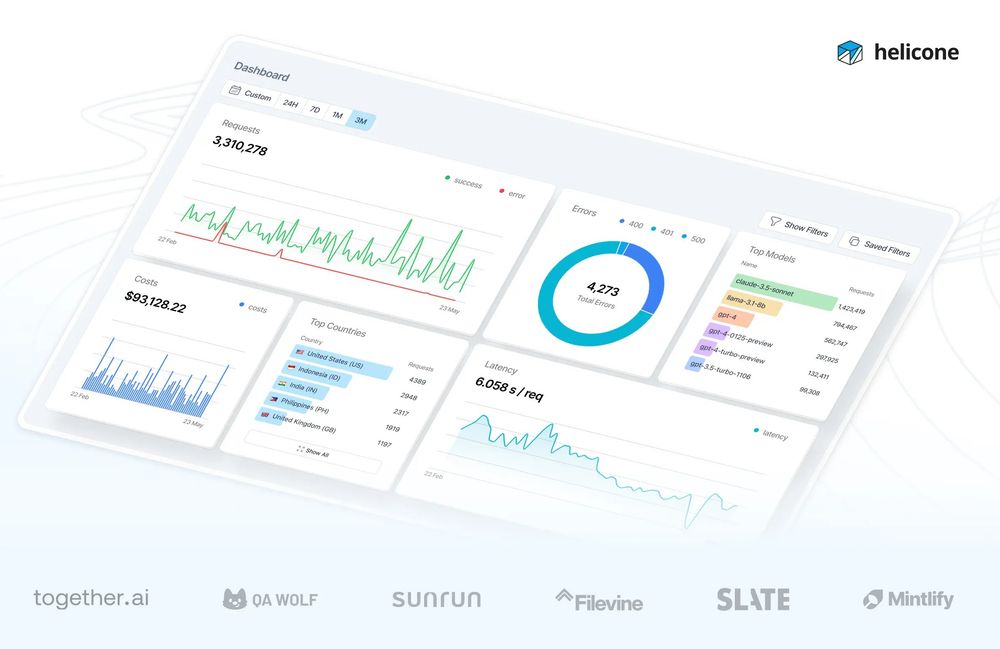
That gateway path is useful when reliability matters: Helicone documents intelligent routing and automatic fallbacks, so a request can move to a backup provider when a provider fails. It also offers unified billing through credits with 0% markup, while BYOK remains available for teams that prefer their own provider keys. On the observability side, the platform tracks usage, costs, latency, and errors across providers. Sessions and user analytics help reconstruct conversations and multi-step agent workflows; custom properties support breakdowns by feature or user; HQL supports querying; and the product exposes prompts, datasets, playground, caching, rate limits, alerts, and reports. Those pieces make a concrete loop: send traffic through one endpoint, find a failing or expensive request, inspect its surrounding session and dimensions, then adjust routing, limits, prompts, or provider choice.
The fit is less about generic infrastructure monitoring and more about production LLM behavior. A chatbot team can investigate a disputed answer in its conversation history; an agent team can trace where a multi-call sequence breaks; and a platform team can compare provider cost and error patterns without maintaining separate integrations. Helicone’s own documentation also describes an observability-only mode with your provider keys, which is a useful option when gateway billing or provider-key consolidation is not the goal. The public site currently identifies Helicone as part of Experiential Labs, while the docs and pricing pages remain available for the product workflow described here.
Alternatives
Braintrust is the closest catalog alternative for teams prioritizing LLM tracing, scoring, and evaluation of applications and agents; Helicone differs by putting a multi-provider gateway, routing, fallbacks, and unified billing alongside observability. Comet is a broader AI observability and machine-learning platform whose catalog listing emphasizes Opik tracing, evaluation, and experiment management; Helicone is more directly centered on request routing and operational LLM gateway traffic. New Relic covers application performance, infrastructure, logs, digital experience, and AI monitoring across a general observability stack; Helicone is the more specialized choice when the primary data is LLM requests, prompts, sessions, provider costs, and failover behavior.
Pricing
Helicone pricing lists a Hobby plan at Free with 10,000 requests, 1 GB storage, one seat, one organization, and seven-day retention. Pro is $79 per month and Team is $799 per month; both also state that usage-based pricing applies. Pro includes unlimited seats, alerts and reports, and HQL; Team adds five organizations, SOC-2 and HIPAA compliance, and a dedicated Slack channel. Enterprise is Contact us and lists custom packages, custom MSA, SAML SSO, on-prem deployment, and bulk cloud discounts. The page also says credits use 0% markup and offers a seven-day free trial for Pro and Team. Helicone therefore fits the Open Source label here because its official documentation presents Helicone OSS, while the hosted service has the paid plans above; the pricing page should be checked for changes before publication.
FAQ
Does Helicone replace every provider SDK? The documented gateway uses the OpenAI SDK format and a single endpoint to access 100+ models, translating requests for providers such as Anthropic and Google. Existing integrations can also use the provider-specific integration paths listed in the official site and docs.
How quickly can a developer test it? The quickstart says the first request can be logged in under two minutes: create an account and API key, change the OpenAI client base URL and key, then send a request in TypeScript, Python, or cURL.
Can Helicone keep an AI app available during provider failure? Yes. The official gateway documentation describes intelligent routing and automatic fallbacks across providers, with the response returned through the same gateway and the request still observed.
Can a team use its own provider accounts? Yes. Helicone documents BYOK through provider-key configuration, while the credits route lets Helicone manage provider keys and billing with 0% markup.
What is included in the free plan? The pricing page lists Hobby as free with 10,000 requests, 1 GB storage, one seat, one organization, and seven-day retention. It does not mean unlimited hosted usage; Pro, Team, and Enterprise have their separate limits or commercial terms.