

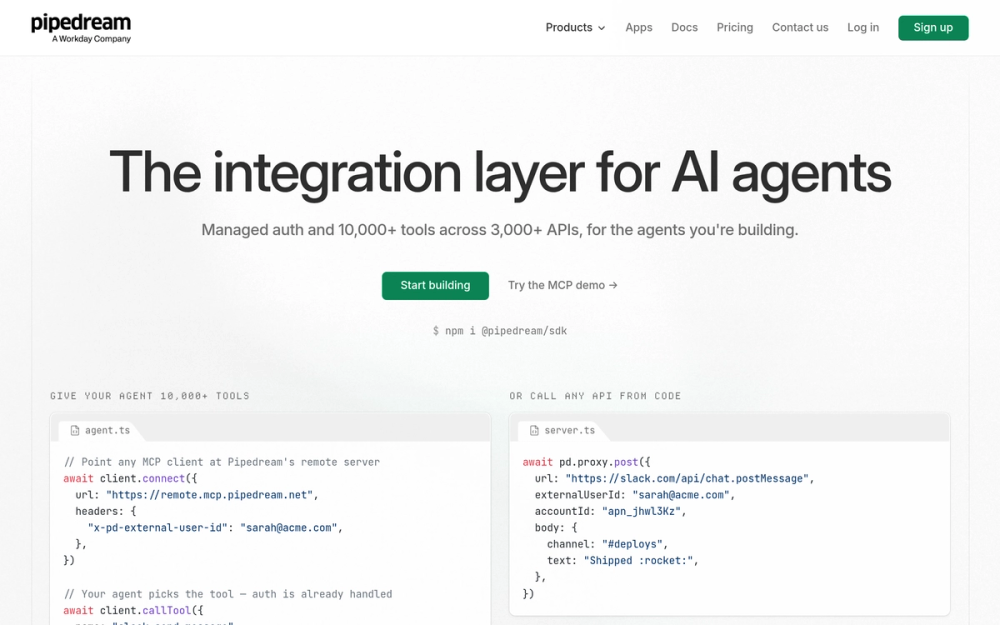
What is Pipedream?
Pipedream is an integration layer for AI agents that provides managed authentication and 10,000+ prebuilt tools across 3,000+ APIs, so developers can connect agents to their users' apps without building OAuth flows or hosting integration infrastructure. Pipedream differentiates itself by combining hosted auth, a raw API proxy, MCP servers, and prebuilt tools and triggers in a single managed runtime.
Key Features
- Remote MCP server: Pipedream exposes a remote MCP endpoint at
https://remote.mcp.pipedream.netthat any MCP client can connect to, giving agents access to 10,000+ tools with per-user authentication handled automatically. - Managed auth for 3,000+ APIs: Pipedream runs the full authorization flow, including hosted OAuth clients, encrypted token storage, and automatic token refresh, so developers never handle credentials directly.
- Connect Link and browser SDK: Developers can send users a hosted Connect Link or embed the connection flow with the browser SDK, letting users authorize accounts in seconds without custom UI work.
- Raw API proxy: The
pd.proxymethod lets code call any API directly, with fresh per-user tokens injected on every request using anexternalUserIdandaccountId. - Prebuilt tools and triggers: Pipedream ships 10,000+ prebuilt tools and triggers, such as
slack-send-messageandstripe-list-customers, that agents can discover and run. - Multi-language SDKs: Pipedream supports TypeScript, Python, Java, and REST, and the SDK is installable via
npm i @pipedream/sdk. - Tool discovery for agents: Agents can find the tools they need through built-in tool discovery rather than requiring hardcoded tool lists.
- Conduit (early access): A gateway for companies that lets employees safely connect their apps to AI agents, with SSO, access policies, per-user permissions, and a full audit trail managed in one place.
Use Cases
- AI agent developers: A developer building an agent that invoices new Stripe customers and posts a summary to a Slack channel can point the agent at Pipedream's MCP server and let it run the Stripe and Slack tools with each user's connected accounts.
- SaaS products adding integrations: Teams can launch a full integration catalog in days using Connect Link or the browser SDK, with requests running in Pipedream's managed runtime and no OAuth apps to register or infrastructure to host or scale.
- Backend and server-side workflows: Developers can call any API from code through the proxy, injecting fresh per-user tokens on every request without building token management.
- Enterprise agent rollouts: Companies can use Conduit to give employees a controlled way to connect their apps to AI agents, with SSO, access policies, and an audit trail.
- Multi-language teams: Teams working in TypeScript, Python, Java, or REST can integrate through the corresponding SDK or the REST interface.
Who It Is For
Pipedream is built for developers and companies building AI agents and agent products that need to act on behalf of users across many third-party apps. It solves the integration burden of registering OAuth apps, storing and refreshing credentials, hosting connection flows, and maintaining tool coverage, replacing that work with a managed auth layer, prebuilt tools, and a proxy for everything else.
Pricing
The source material does not state Pipedream's pricing model, free tier, or trial terms. Pricing details should be confirmed directly on the Pipedream website.
Frequently Asked Questions
What is Pipedream used for?
Pipedream is an integration layer for AI agents. It provides managed authentication and 10,000+ prebuilt tools across 3,000+ APIs, plus a raw API proxy, so agents can call services like Slack and Stripe using each user's connected accounts.
How do AI agents connect to Pipedream?
Any MCP client can connect to Pipedream's remote MCP server at https://remote.mcp.pipedream.net with an x-pd-external-user-id header. The agent then discovers and calls tools such as slack-send-message, with authentication already handled by Pipedream.
Does Pipedream handle OAuth and token refresh?
Yes. Pipedream runs the entire authorization flow for 3,000+ APIs, including hosted OAuth clients, secure token storage encrypted at rest and scoped per project, and automatic refresh. Developers can also bring their own OAuth clients when preferred.
Which languages and interfaces does Pipedream support?
Pipedream offers SDKs for TypeScript, Python, and Java, plus a REST interface and MCP. The SDK is available via npm i @pipedream/sdk, and agents can connect through MCP or code can call APIs through the proxy.
Who should use Pipedream?
Pipedream is aimed at developers building AI agents and at companies deploying agents internally. It suits teams that want to skip building OAuth flows, credential storage, and integration hosting, and instead ship a full integration catalog using Pipedream's managed runtime.