

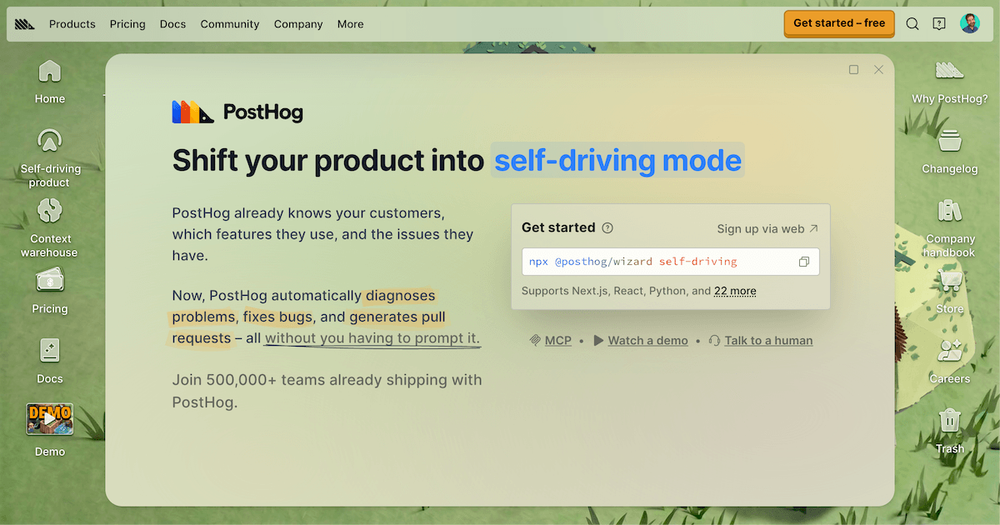
What is PostHog?
PostHog is a product analytics and developer platform that bundles many tools teams usually buy separately. Instead of wiring together an analytics tool, a session recorder, a feature flag service and an A/B testing product, you install PostHog once and get all of them on top of the same event data. Its source code is public on GitHub, and it is known for transparent, usage-based pricing and a generous free tier.
Key features
- Product analytics: funnels, trends, retention, paths and SQL-based insights on your event data.
- Web analytics: a simple traffic dashboard for page views, referrers and visitors.
- Session replay: watch real user sessions to see where people get stuck, including on mobile.
- Feature flags: roll features out gradually, target specific users and kill switches.
- Experiments: A/B and multivariate tests tied to your product metrics.
- Surveys: in-app questionnaires and feedback forms.
- Error tracking: capture exceptions and link them to the sessions where they happened.
- Data warehouse and pipelines: bring in data from external sources and send events to other tools.
- AI features: PostHog AI helps you ask questions about your data in plain language.
Who is it for?
PostHog is built for engineers and product-minded teams at startups and scale-ups who want to understand user behavior without stitching together several vendors. It is popular with developer-led companies because the SDKs, APIs and docs are written for engineers.
Use cases
- Measuring activation and conversion funnels for a SaaS product
- Safely shipping new features behind flags
- Running pricing or onboarding experiments
- Debugging user-reported bugs with session replays and error tracking
- Collecting user feedback with targeted surveys
Pricing
PostHog uses usage-based pricing with a free allowance on each product, and you only pay for usage above it. Enterprise plans are available. Exact allowances and rates are listed on the official PostHog pricing page.
What's new and trending
PostHog ships continuously from its public repository, with new releases published several times a day. For example, the PostHog desktop app v0.61.844 was released on October 26, 2026 (release notes), along with frequent updates to its agent skills package.
Getting started
- Sign up at posthog.com and create a project.
- Add the JavaScript snippet or install an SDK (for example
posthog-js) for your framework. - Start capturing events and turn on session replay.
- Build your first funnel or dashboard.
- Create a feature flag and wrap a new feature in it.
Alternatives
For open-source web analytics, see Plausible Analytics and Umami. For feature flags and experiments, compare LaunchDarkly, GrowthBook, Flagsmith and Unleash. For error monitoring, Sentry is the best-known option.
FAQ
Is PostHog free? PostHog has a free tier with a monthly allowance for each product. You pay only for usage above that allowance.
Is PostHog open source? PostHog's code is public on GitHub. Most teams use PostHog Cloud, which is the hosted version.
Can PostHog replace Google Analytics? For many teams, yes. PostHog includes web analytics as well as deeper product analytics on individual users and events.
Does PostHog support feature flags? Yes. Feature flags and experiments are built in and use the same user data as analytics.
Does PostHog work on mobile? Yes. PostHog offers SDKs for iOS, Android, React Native and Flutter, and supports mobile session replay.


