

What is Pulumi?
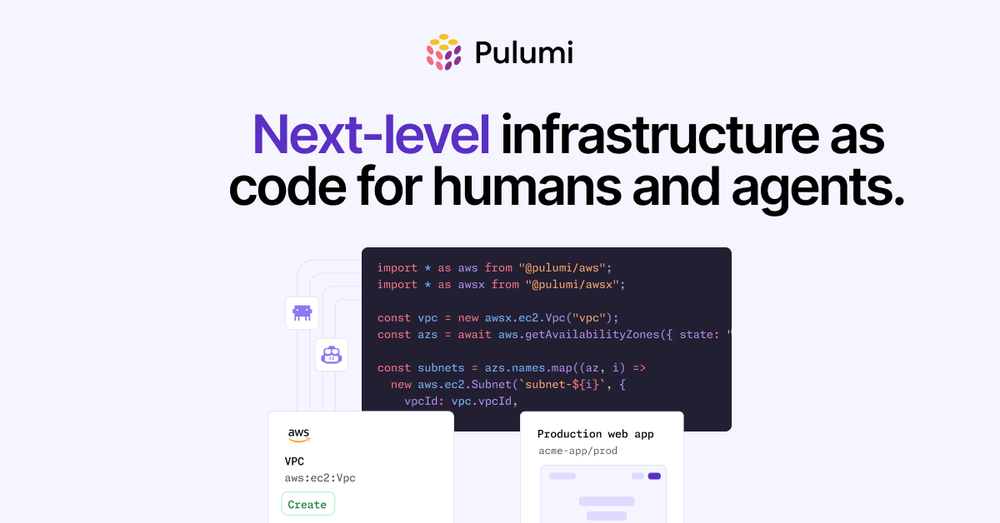
Pulumi is an open-source infrastructure as code platform that lets humans and AI agents build and manage cloud infrastructure using general-purpose programming languages and configuration languages. Unlike tools limited to a single domain-specific language, Pulumi supports TypeScript, Python, Go, .NET, YAML, and HCL, and adds an AI platform engineer called Pulumi Neo plus open-source skills that work with existing coding agents.
Key features
- Multi-language infrastructure as code: Build infrastructure with modern languages such as TypeScript, Python, Go, and .NET, or with configuration languages like YAML and HCL, so teams can use the tooling they already know.
- Reusable components and package managers: Compose infrastructure using the full capabilities of a preferred language, then share reusable components through package managers including npm, PyPI, and NuGet.
- Full IDE support: Get type checking, code navigation, inline documentation, and testing by working in a standard development environment rather than a bespoke DSL.
- Security and compliance controls: Meet compliance requirements with encrypted secrets, dynamic credentials, policy as code, and full audit trails; Pulumi is SOC 2 Type II certified.
- Centralized configuration and secrets (Pulumi ESC): Manage secrets through a single interface that pulls in Vault, AWS Secrets Manager, Azure Key Vault, and more, with support for short-lived credentials via OIDC.
- Discovery and governance: Use natural language queries to find managed and unmanaged resources, even across clouds, enforce policies, track compliance in real time, and find vulnerabilities before they become incidents.
- Self-service infrastructure (IDP): Define golden paths for approved infrastructure with configurable components and customizable templates that enable developers while keeping platform teams in control.
- Pulumi Neo and agent skills: An AI agent built for infrastructure that understands code and organizational context, respects policies, and executes complex tasks end-to-end, with or without a human in the loop; open-source skills work with any coding agent.
Who is it for?
Pulumi targets platform engineers, DevOps and cloud infrastructure teams, and application developers who need to provision and manage cloud resources across multiple clouds and regions. It suits organizations that want infrastructure defined in the same languages and workflows as their application code, and teams looking to let AI coding agents participate in infrastructure work under policy guardrails.
Use cases
- Multi-cloud Kubernetes management: Set up and manage multi-cloud, multi-region Kubernetes clusters that infrastructure and application teams can use collaboratively.
- Platform teams building golden paths: Define approved, reusable infrastructure components and templates so developers can self-serve while platform teams retain control.
- Security and compliance enforcement: Apply policy as code, encrypted secrets, dynamic credentials, and audit trails to keep infrastructure compliant across environments.
- Cross-cloud resource discovery: Use natural language queries to locate managed and unmanaged resources across clouds and surface vulnerabilities before they become incidents.
- Agent-assisted infrastructure delivery: Let coding agents or Pulumi Neo automate infrastructure workflows using organizational context and best practices.
Pricing
The source material does not list public pricing figures. Pulumi is described as open source, and the site offers a "Get started" path and a downloadable open-source option, but no tier or price details were provided.
What's new and trending
The source highlights native support for Terraform and HCL, positioned as a way to let agents work on infrastructure without going off the rails. It also promotes Pulumi Neo, described as the first AI agent built for infrastructure, alongside open-source skills that integrate with existing coding agents. No version numbers or release dates are stated.
Getting started
The source lists "Get started" and "Download open source" calls to action, along with a dashboard and sign-in path, but it does not document specific setup steps or a public getting-started guide.
Alternatives
The source does not name competing products. It references Terraform and HCL only in the context of Pulumi's own native support for those formats, not as alternatives.
FAQ
What is Pulumi used for? Pulumi is used to define, deploy, and manage cloud infrastructure as code using languages such as TypeScript, Python, Go, .NET, YAML, and HCL. It also provides governance, secrets management, self-service infrastructure templates, and AI agent capabilities for infrastructure work.
Is Pulumi free? Pulumi is described as an open-source platform with a downloadable open-source option, but the source material does not list pricing tiers or figures, so paid plan costs are not confirmed.
Which programming languages does Pulumi support? Pulumi supports TypeScript, Python, Go, and .NET, plus configuration languages YAML and HCL.
What is Pulumi Neo? Pulumi Neo is described as the first AI agent built for infrastructure. It understands code and organizational context, respects policies, and executes complex tasks end-to-end with or without a human in the loop, and it works alongside existing coding agents.
Does Pulumi support Terraform and HCL? Yes. The source lists native support for Terraform and HCL among Pulumi's current capabilities.