

What is Statsig?
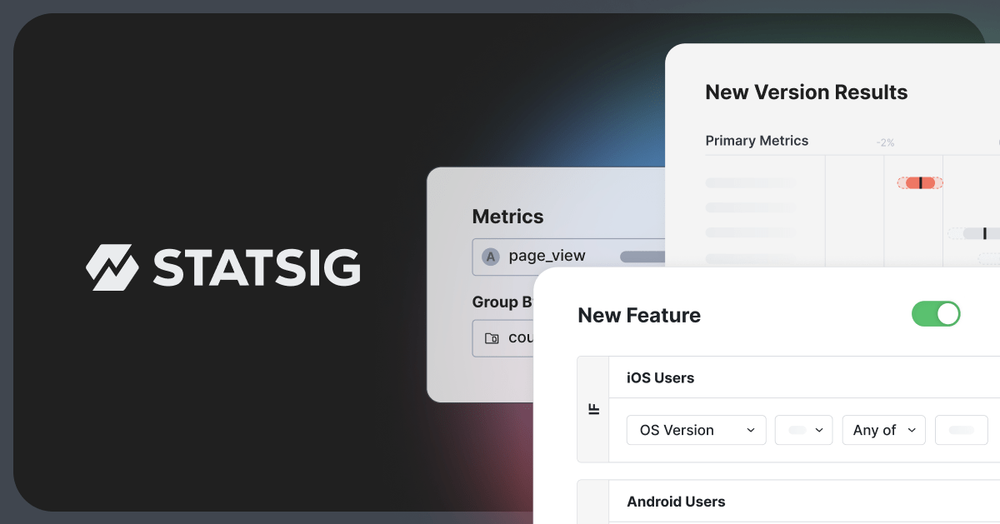
Statsig is a modern product development platform that combines experimentation, feature management, product analytics, session replay, and web analytics in a single integrated toolkit for engineering, data science, product, and DevOps teams. Statsig differentiates itself by linking feature flags, experiments, and metrics directly to product data, backed by infrastructure that processes over one trillion events per day with 99.99% uptime.
Key Features
- Experimentation: A platform for running sophisticated tests and computing results with advanced statistical treatments, including support for warehouse-native experimentation so teams can run tests against data in their own warehouse.
- Feature Management: A feature flagging platform that gives teams complete control over the release process, with flags linked directly to product data and built to handle massive scale.
- Product Analytics: A set of analytics tools built for data teams to establish a trusted set of product metrics, track progress, and turn action into insights.
- Session Replay: Replays of how users engage with an app or website, linked to every feature flag, experiment, and metric so teams can isolate user painpoints and identify trends.
- Web Analytics and Infra Analytics: Dedicated analytics products for web traffic and infrastructure, alongside marketing experiments, extending the platform beyond core product metrics.
- Dynamic Configs, Parameter Stores, and Layers: Configuration tools that let teams adjust product behavior without shipping code, alongside holdouts, autotune, and power analysis for experiment design.
- Metrics Explorer, Logs Explorer, and User Segments: Tools for exploring metrics and logs and building user segments, supported by events ingestion for feeding product data into the platform.
- Warehouse-Native Infrastructure and SDKs: A warehouse-native architecture with SDKs and integrations, plus a no-code editor for visual workflows.
Use Cases
- Product and growth teams running experiments: Teams can design tests, apply advanced statistical treatments, and analyze results in one place, scaling an experimentation culture without stitching together separate tools.
- Engineering teams managing releases: Developers can gate features behind flags tied to product data, controlling rollout and protecting user trust while measuring how each release lands.
- Data teams consolidating tooling: Data teams can build a single trusted set of product metrics and consolidate product data, experimentation, and analytics; Brex's data teams reported a +50% time efficiency gain from consolidating with Statsig.
- UX and product researchers investigating painpoints: Teams can watch session replays linked to specific flags, experiments, and metrics to dig into where users struggle and spot emerging trends.
- Companies testing AI-powered experiences: Teams can test how each release, from features to AI-powered experiences, lands with customers and optimize at the speed of AI.
Who It Is For
Statsig serves engineering, DevOps, data science, product management, and marketing roles across gaming, B2B SaaS, e-commerce, and startups. It targets teams that need to measure what ships and ship what matters, replacing a patchwork of separate experimentation, flagging, and analytics tools with one platform that keeps release decisions tied to product data.
Pricing
Statsig offers a free account option and directs teams to contact sales for further pricing details. The source material does not list specific price figures.
Frequently Asked Questions
What is Statsig used for?
Statsig is used to test and measure product releases, manage feature rollouts with feature flags, analyze product data, and review session replays. It combines experimentation, feature management, product analytics, session replay, web analytics, and infrastructure analytics in one platform.
Is Statsig free?
Statsig offers a free account that teams can create to get started. Specific paid pricing tiers are not detailed in the available source material, and teams are directed to contact sales.
Who should use Statsig?
Statsig is built for engineering, DevOps, data science, product management, and marketing teams, particularly in gaming, B2B SaaS, e-commerce, and startups. It suits organizations that want experimentation, feature flags, and analytics connected through shared product data.
How does Statsig handle scale and reliability?
Statsig reports processing over one trillion events per day, serving 2.5 billion unique monthly experiment subjects, maintaining 99.99% uptime for its API and console, and delivering post-init evaluation latency under one millisecond.
What is Statsig's relationship to Amplitude?
Statsig is part of the Amplitude family, according to the source material. The platform continues to operate its integrated product suite, including experimentation, feature flags, analytics, and session replay.