
What is Zencoder?
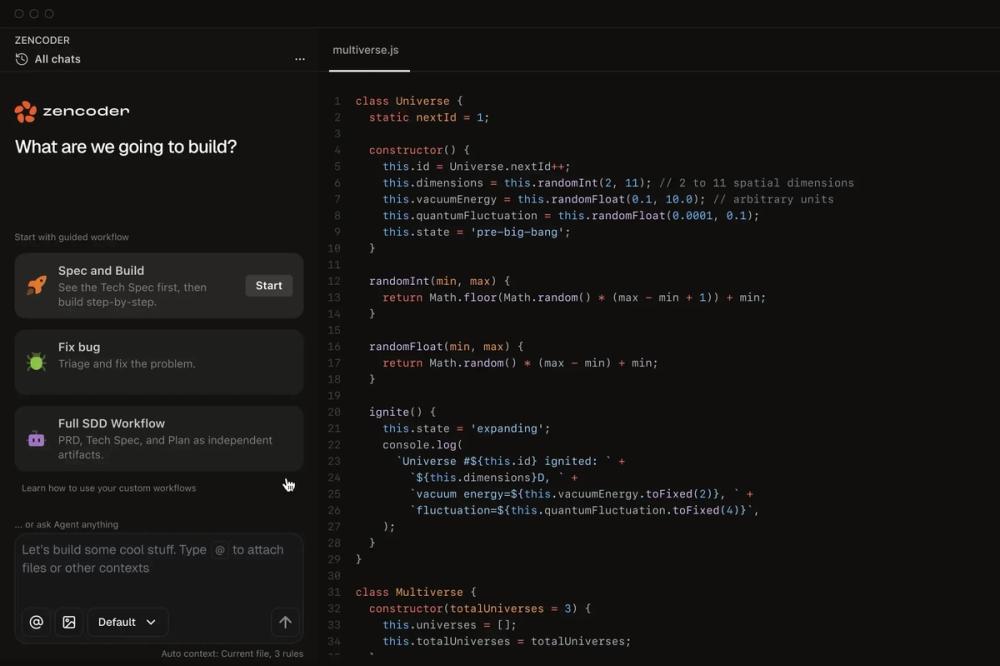
Zencoder is an AI agent platform for software teams that want more than autocomplete. Its current product family combines Zenflow Code, Zenflow Work, and IDE Agents: agents can plan, implement, test, debug, refactor, and review work across a codebase, while business workflows can be handled through connected tools. The central idea is orchestration rather than a single assistant. Zencoder’s official site describes assigning different frontier models to different phases—for example, planning, building, and review—so teams can match model choice to the job and add an independent verification pass.
Best for
Zencoder is best for developers and engineering teams working on multi-file or multi-repository changes, structured feature delivery, bug fixing, testing, and code review. The IDE Agents work inside VS Code and JetBrains products, with the official product page also naming IntelliJ, PyCharm, WebStorm, and Android Studio. The product is a particularly good fit when an organization wants repeatable workflows: the documented options include Auto, Spec First, Requirements First, multi-model, and custom workflows. Zencoder also supports Zenflow Code for isolated, parallel task execution with Git worktrees and verification, and Zenflow Work for goal-driven automations across workplace tools.
The platform is less obviously suited to someone who only wants inline completion or a lightweight chat panel. Its value is in repository context, multi-file operations, workflow checkpoints, integrations, and reviewability. Official documentation says agents can index and search multiple repositories, use skills as reusable instruction packages, connect through MCP, and work with Claude, GPT, Gemini, Grok, or a user’s own API key. Those capabilities make it worth evaluating for teams that need an operating layer around coding agents, not just generated snippets.
Alternatives
OpenHands is the closest direct alternative in this set. Its official OpenHands repository describes Agent Canvas as a self-hosted control center for coding agents and automations, with local, remote, cloud, and multiple-agent backends. It is a strong comparison for teams prioritizing open-source software, self-hosting, or the ability to switch among agent backends.
Lovable is an adjacent option rather than a one-for-one IDE-agent replacement. Lovable’s official site focuses on describing and shipping full-stack products in natural language, with hosting, authentication, integrations, and deployment handled by the platform. Choose it when the goal is rapidly creating an application, rather than orchestrating repository-centered engineering workflows across an existing stack.
NocoBase is another adjacent comparison. NocoBase’s official site positions Core as an open-source foundation for business systems and Studio as a governance platform that coordinates coding agents, issues, skills, and evidence. It may be a better fit for self-hosted business applications with structured permissions and workflows; Zencoder is broader as a general coding and work-agent platform.
Pricing
The official pricing page currently lists Pro at $45 per user per month monthly, or $40 per user per month billed annually, after a seven-day Pro trial with 5,000 credits. Pro includes 30,000 monthly credits, top-ups, frontier models, BYOK, Zenflow Desktop, and IDE plugins. Pro Plus is listed at $95 monthly or $85 annually per user and includes 80,000 monthly credits, shared team pools, multi-repository indexing, analytics, SSO, and audit logs. Pro Max is listed at $195 monthly or $175 annually per user with 180,000 monthly credits and priority support. Enterprise pricing is custom and includes private deployment and professional services. The official site says credits expire at the end of the billing period, while top-up credits remain usable; BYOK calls do not consume bundled credits. Confirm current terms before purchase.
FAQs
Does Zencoder work inside my IDE?
Yes. The official coding-agent page lists VS Code and JetBrains support, and names IntelliJ, PyCharm, WebStorm, and Android Studio. It describes inline suggestions, chat, multi-file editing, workflows, and repository-aware agents.
Can Zencoder work across more than one repository?
Yes. Zencoder’s official pages describe multi-repository indexing, dependency mapping, and cross-repository search. Multi-repository indexing is also listed as a Pro Plus feature on the current pricing page.
What does multi-model orchestration mean in Zencoder?
It means assigning different models to stages of one workflow, such as using one model for planning, another for implementation, and another for review. The official documentation presents this as a way to balance quality, speed, and cost rather than locking every step to one model.
Does Zencoder run tests and verify generated changes?
The official product materials describe built-in verification, tests, linting, code review, and multi-model validation. The exact commands and gates depend on the workflow and repository configuration, so teams should test their own standards before relying on automation.
Can I use my own model API keys with Zencoder?
Yes. The official pricing page says BYOK is supported for OpenAI, Anthropic, or Gemini, and that calls made through a user’s own API key do not consume bundled credits. The account still needs to meet the applicable plan and provider requirements.