

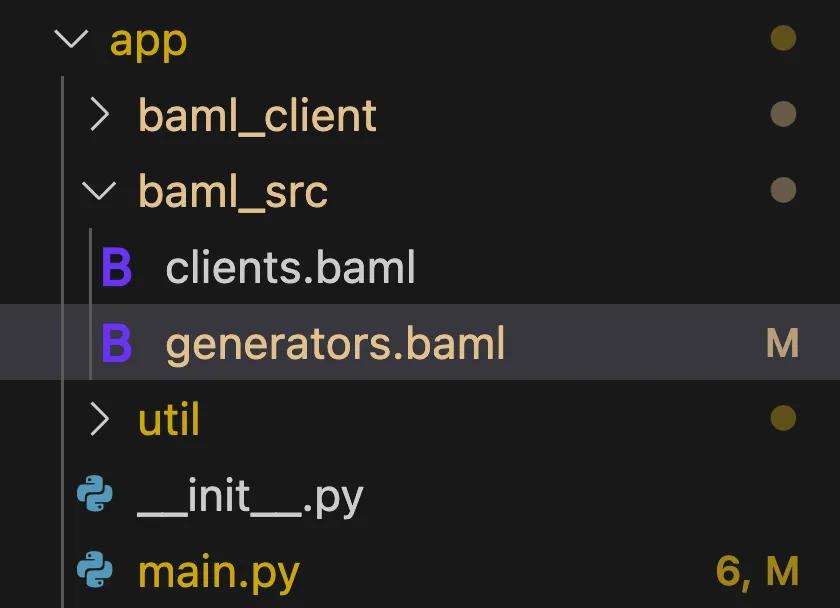
What is BAML?
BAML is an open-source programming language and toolchain for building AI agents and reliable LLM applications. It gives developers a typed way to describe AI functions, prompts, tools, and returned data, then generates client code that can be called from application languages. The official repository describes BAML as “the programming language for agents,” while the current homepage presents a broader toolchain for building, testing, tracing, querying, and operating agent programs.[1][3]
Best for
BAML is best for teams that want AI behavior to look more like ordinary, testable software than a collection of loosely typed prompt strings. A BAML function can declare its inputs and output class, select an LLM client, and keep the prompt close to the contract. The documentation’s example generates a WeatherAPI result and shows calls from Python, TypeScript, Go, and Ruby.[2] The generated client handles boilerplate around calling the model, parsing output, fixing broken JSON, and reporting errors, according to the official guide.[2]
It is a strong fit for developers who need structured extraction, typed tool interfaces, repeatable tests, or a gradual migration path. The documentation explicitly says BAML can work alongside an existing LLM framework rather than requiring a full rewrite.[2] The repository also lists built-in tests and an eval framework, runtime-persistent types, typed errors, concurrency, and an incremental adoption model across languages.[3] Use it when the contract between an AI function and the rest of your application matters as much as the prompt itself.
Alternatives
AI SDK is an adjacent TypeScript-first option. Vercel’s official documentation describes it as a toolkit for AI applications and agents, with core APIs for text, structured objects, tool calls, and agents.[4] Choose it when your main need is provider-neutral TypeScript integration and UI or application surfaces; choose BAML when a dedicated language, generated clients, and explicit AI-function contracts are the priority.
Langfuse overlaps with BAML’s operational side rather than replacing its language layer. Its official documentation describes an open-source, self-hostable AI engineering platform for tracing, debugging, evaluation, prompt management, and analysis of agent applications.[5] It is the closer choice when observability and production investigation lead the project. BAML is the closer choice for defining and calling typed AI functions; the two categories can be complementary.
LlamaIndex is an adjacent agent and data framework. Its official documentation positions the open-source Python toolkit around agents, workflows, connectors, indexes, retrieval, and context augmentation over private data.[6] Pick it for document-heavy RAG and data-connected agents. Pick BAML for a language-level contract around prompts, schemas, generated clients, and agent code. They address different layers and can be used together in a larger application.
Pricing
The official BAML homepage says BAML is fully open-source and completely free to use.[1] The repository is licensed under Apache License 2.0.[3][7] The homepage separately describes Boundary Cloud as a production data lake and invites users to request early access; it does not publish a current paid-plan price in the sources consulted.[1] Treat the open-source language and any hosted Boundary service as separate purchasing questions, and confirm current commercial terms with Boundary before procurement.
FAQs
1. What languages can call BAML-generated functions?
The official guide demonstrates Python, TypeScript, Go, and Ruby clients, and says to consult the installation guides for other languages.[2] The repository also says BAML can be called from TypeScript, Python, Go, C#, Java, and other application environments.[3] Confirm the current support level for a specific language in the installation documentation before committing to it.
2. Does BAML require migrating an entire LLM application?
No. The official documentation says BAML works alongside an existing LLM framework and that you do not need to migrate 100% of your LLM code at once.[2] This supports introducing it around selected structured-output or agent functions first, then expanding only where its contracts and generated clients are useful.
3. What does the generated client do?
The documentation says generated client code provides boilerplate for calling the LLM endpoint, parsing the response, fixing broken JSON, and handling errors. It also describes type safety, autocomplete, retry logic, and robust JSON parsing when calling the generated function.[2] These are documented behaviors, not a guarantee that every model response will be correct without application-level tests.
4. Is BAML a hosted API or a language you run in your project?
BAML is presented as a programming language and open-source toolchain that can be installed and run with a CLI, while its runtime can optionally send program data to Boundary Cloud for production analysis.[1][3] The official sources do not say that using the language requires a hosted Boundary account. They do describe Boundary Cloud as a separate early-access service, so verify deployment and telemetry settings for your environment.
5. Is BAML free for commercial use?
The homepage says BAML is completely free to use, and the repository includes an Apache 2.0 license.[1][7] Apache 2.0 generally permits commercial use subject to its terms, notices, and conditions. This statement applies to the open-source repository as licensed; it does not establish pricing or terms for Boundary Cloud, support, or other hosted offerings.


