

What is Encore?
Encore is a development platform for building and deploying backend applications without hand-managing every infrastructure detail. Its open-source SDK and CLI let developers describe services and infrastructure in TypeScript or Go, run that system locally, and deploy to their own AWS or Google Cloud account through the optional Encore Platform. The practical appeal is a single application model that spans local development, testing, preview environments, deployment, and observability.
Best for
Encore is best for backend teams that want infrastructure-from-code without giving up ownership of their cloud account. It is a strong fit for TypeScript or Go projects that need more than a single function: services, APIs, SQL databases, Pub/Sub, object storage, caches, cron jobs, secrets, and service-to-service calls can be declared in code. The official quickstart demonstrates a PostgreSQL-backed URL shortener, a second service, a Pub/Sub topic, local execution, request traces, and cloud deployment.
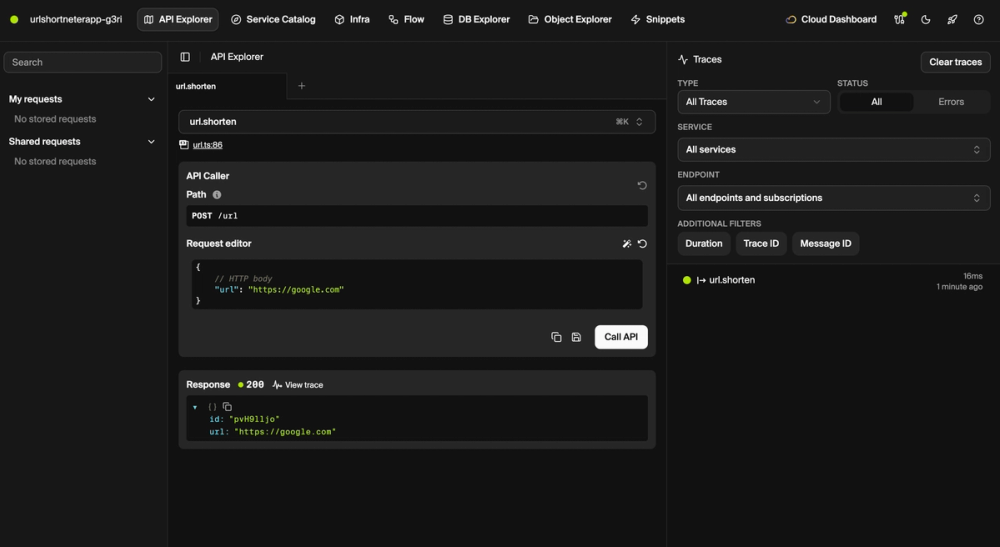
The local loop is unusually concrete. Running encore run can provision local PostgreSQL through Docker, expose an API Explorer and generated documentation, and provide a dashboard with traces, logs, a database explorer, and Encore Flow architecture visualization. Encore’s documentation says request traces capture timing, API calls, database queries, published messages, payloads, and correlated logs without requiring logging or instrumentation code for the example workflow.
For production, the platform can provision matching infrastructure in the customer’s AWS or GCP account. The official Go documentation also documents a self-hosting path: build a standard Docker image with encore build docker, provision infrastructure independently, and provide an infrastructure configuration. That makes Encore more than a hosted runtime, but it also means teams should understand the boundary between the open-source framework and the paid platform before adopting it.
Alternatives
- Vercel — a direct alternative when the priority is a managed deployment platform with preview URLs, serverless functions, global delivery, and strong frontend integration. Vercel’s official site also now highlights backends, queues, daemons, and agent infrastructure. Compared with Encore, Vercel centers on its managed platform, while Encore emphasizes declaring backend infrastructure in code and deploying that infrastructure into your own AWS or GCP account.
- Dokploy — a direct alternative for teams seeking a self-hostable deployment control plane. Dokploy’s official site describes application and database deployments across servers, Docker Compose support, multi-server deployment, monitoring, backups, and managed or self-hosted operation. It is closer to an application deployment interface around containers; Encore is more opinionated about typed services, application topology, and infrastructure declarations in TypeScript or Go.
- Cloudflare Workers — an adjacent option rather than a one-for-one replacement. Cloudflare’s official product page describes globally distributed serverless functions with JavaScript, TypeScript, Python, Rust, V8 isolates, bindings to services such as R2 and D1, and CPU-time billing. It is compelling for edge APIs and globally distributed request handling, whereas Encore targets a broader backend application model with local infrastructure, service calls, databases, messaging, and cloud-account deployment.
Pricing
Encore’s official pricing page lists a free Starter plan with local development, automated infrastructure, two free development environments on Encore Cloud, one million tracing events per month with seven-day retention, CI/CD and automated testing, and Discord support. The Pro plan is listed at $49 per member per month, plus $99 per AWS/GCP environment per month, $2.50 per resource per environment per month, and $1.20 per million tracing events after 20 million included. Cloud infrastructure is billed directly by AWS or GCP. Enterprise pricing is custom. The page also states that Pro has a 14-day free trial and that Starter is free for local development and small projects. Prices and inclusions can change, so confirm the official pricing page before purchase.
FAQs
Does Encore support both Go and TypeScript?
Yes. Encore’s homepage and quickstart document both Encore.go and Encore.ts. The homepage says Python and Rust are coming soon, so those should not be described as currently supported first-class Encore languages based on this research.
Does Encore require Terraform or YAML for its core workflow?
No. Encore’s official pages describe infrastructure declared in application code and explicitly position the workflow as infrastructure as code without Terraform or YAML. Deployment-specific settings remain separate, and teams can still provision external dependencies themselves when a needed service is outside Encore’s built-in primitives.
What infrastructure can Encore model?
Official documentation lists SQL databases, Pub/Sub topics and subscriptions, object storage, caches, cron jobs, secrets, services, and APIs. The exact cloud implementation depends on the environment: examples include Postgres locally, RDS on AWS, Cloud SQL on GCP, S3 or Cloud Storage, and AWS or GCP messaging equivalents.
Can an Encore application be self-hosted?
Yes. The official Go documentation says the application can be built as a standard Docker image with encore build docker. In that route, the team provisions infrastructure independently and supplies the configuration needed to connect the runtime to it. This is distinct from using the Encore Platform as the deployment control plane.
What is included in the free Starter plan?
The official pricing page lists local automated infrastructure, no-Terraform/YAML infrastructure as code, two free Encore Cloud development environments, one million tracing events per month with seven-day retention, CI/CD and automated testing, and Discord community support. It does not make Starter equivalent to Pro: deployment to the customer’s own AWS/GCP account and automatic cloud provisioning are listed under Pro.



