

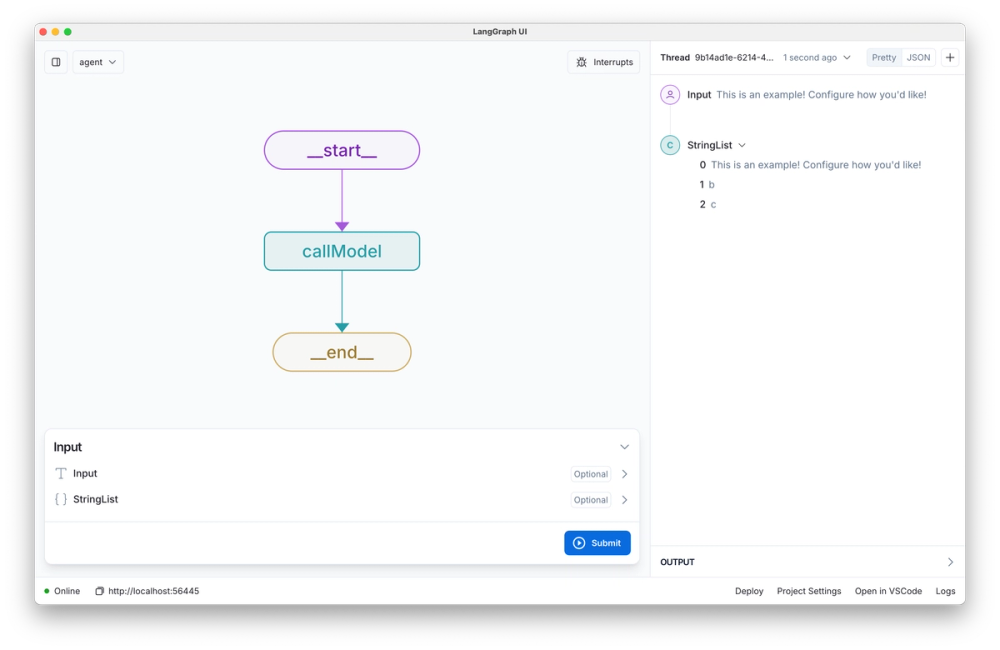
What is LangGraph?
LangGraph is a low-level orchestration framework and runtime for building long-running, stateful agents. Instead of hiding control flow behind a fixed agent loop, it lets developers define a graph made from shared state, nodes, and edges. That makes it a practical choice when an agent needs explicit branching, retries, pauses, persistence, or a mixture of deterministic code and model-driven steps.
The project is built by LangChain and can be used without LangChain. The official documentation presents LangGraph as an orchestration runtime rather than a prompt library or a prescriptive agent architecture. You choose the model and tools, then use the graph runtime to control how work moves through the application. A minimal Python graph can be installed with pip install -U langgraph, and the project also provides a JavaScript/TypeScript library through LangGraph.js.
Best for
LangGraph is best for engineering teams that need fine-grained control over stateful agent workflows. It fits applications that must resume after a failure, preserve thread state, stream intermediate events, or ask a person to review and modify state before continuing. It is also well suited to workflows that combine ordinary application logic with LLM steps: for example, a deterministic validation node can lead to a model call, a conditional branch, and a human approval step in the same graph.
This is a lower-level tool, so it rewards developers who are comfortable designing state, nodes, edges, and execution behavior. It is a stronger fit than a black-box agent loop when the workflow itself is part of the product’s reliability, auditability, or user experience. For a higher-level starting point, LangChain’s documentation points readers toward LangChain agents or Deep Agents; LangGraph remains the option when explicit orchestration control matters most.
Alternatives
- CrewAI — a direct alternative for teams that prefer an opinionated multi-agent model built around agents, crews, tasks, and flows. CrewAI’s official documentation describes collaborative agents, crews, flows, state persistence, and resumable execution. Compared with LangGraph’s graph primitives, CrewAI provides more predefined structure around role-based collaboration.
- LangSmith — an adjacent LangChain product, not a like-for-like orchestration replacement. Its official documentation focuses on tracing, evaluation, production monitoring, dashboards, and debugging. It is a natural companion when a LangGraph application needs observability rather than another workflow runtime.
- LlamaIndex — a comparable adjacent framework with an official Workflows module for event-driven, step-based execution. Its workflow model uses typed events and Python steps for branching, looping, concurrency, retrieval, and agent interactions. It may suit teams already centered on LlamaIndex data and retrieval abstractions, while LangGraph emphasizes shared graph state and explicit orchestration primitives.
Pricing
The official LangGraph product page describes LangGraph as an MIT-licensed, open-source library that is free to use. The official GitHub repository also identifies the project as MIT licensed. The library itself can be installed from the Python package index, while optional LangChain services such as LangSmith have their own account, usage, and billing terms. The official LangGraph sources consulted here do not specify a separate paid LangGraph library tier or a single bundled LangGraph service price. Check the current LangSmith pricing and deployment documentation separately if you need hosted observability or deployment.
FAQs
1. Does LangGraph require LangChain?
No. The official overview says LangGraph works on its own and does not require LangChain. Examples often use LangChain for model and tool integrations, but the orchestration runtime can be paired with other model and tool choices.
2. What is the basic programming model in LangGraph?
You define a state schema, add nodes that read or update that state, connect nodes with edges, and compile the graph before invoking it. Edges can represent normal progression or conditional control flow. The official quickstart demonstrates this pattern with StateGraph, START, and END.
3. How does LangGraph handle pauses and human approval?
Its human-in-the-loop facilities can pause execution so a person can inspect or edit state, then resume the run. This is useful for approval gates, moderation, tool authorization, and other points where an application should not let an agent continue unchecked.
4. What does persistence mean in LangGraph?
LangGraph can checkpoint graph state so a run can resume after a failure or pause. The official documentation distinguishes thread-scoped short-term state from longer-term memory across sessions. Persistence is a runtime capability; the exact storage and deployment arrangement depends on how you build and operate the application.
5. Can LangGraph stream agent progress?
Yes. Streaming is a documented capability. Applications can stream tokens, state updates, and other runtime events while a graph runs, which can make a long-running agent feel responsive and expose progress to a UI. The exact event format depends on the API and implementation used.


