

Overview
Firebase Genkit is Google’s open-source framework for building full-stack AI-powered and agentic applications. It gives developers a common SDK and workflow around model generation, tools, retrieval, structured data, and multi-step application logic instead of requiring each provider’s API to be wired directly into an application. The official documentation describes Genkit as suitable for chatbots, automations, recommendation systems, and other AI features, with a unified interface for providers including Google, OpenAI, Anthropic, xAI, DeepSeek, and Ollama.
Genkit is primarily a server-side development framework. A flow wraps application AI logic in a callable, testable unit, while client helpers can invoke deployed flows from web and mobile applications. Its open-source repository is maintained at genkit-ai/genkit on GitHub, and the repository describes it as built and used in production by Google’s Firebase organization.
Key Features
- Provider-oriented model integration: Genkit’s unified model interface lets teams change or compare model providers without rewriting the surrounding application architecture. The official overview documents support for text and image generation, multimodal input and output, and provider plugins.
- Structured and type-safe application logic: Flows can declare input and output schemas, including runtime validation, and can stream partial results. This is useful when an AI feature must retrieve context, transform input, validate output, call tools, or combine multiple model responses rather than make a single prompt call.
- Agent and tool building blocks: Official documentation lists tool calling, prompt templating, persisted chat interfaces, agentic workflows, and AI-powered retrieval-augmented generation (RAG). These are implementation primitives, not a promise that Genkit supplies a complete autonomous-agent product out of the box.
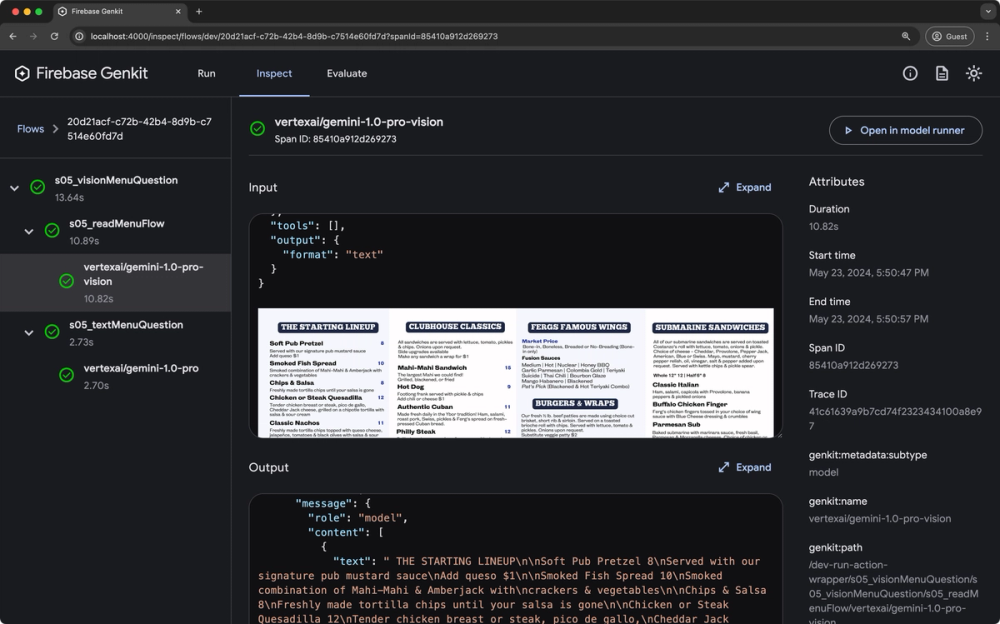
- Local development and evaluation: The Genkit CLI and Developer UI provide flow and prompt playgrounds, execution traces, dataset-based evaluation, and model-output comparison. Developers can run and inspect flows locally before deployment.
- Production observability: Genkit documentation describes monitoring for model performance, request volume, latency, and error rates through a purpose-built dashboard and telemetry integrations.
- Multiple languages: The official repository lists JavaScript/TypeScript and Go as production-ready SDKs with full feature support, Python as Beta, and Dart as Preview. The Genkit getting-started guide provides language-specific paths and examples.
- Deployment flexibility: Genkit can deploy through Cloud Functions for Firebase, Google Cloud Run, or a platform that can run the selected language’s binaries or containers. Its Node deployment guide specifically documents serving flows as an Express.js application.
Use Cases
Genkit fits teams building AI-backed product features rather than teams looking only for a model playground. A customer-support or knowledge assistant can combine generation with RAG, structured responses, tool calls, and persisted chat. A recommendation or personalization service can expose a typed flow that validates input, retrieves application data, and returns a predictable result.
It is also suited to operational automations such as document processing, classification, enrichment, extraction, and multi-step business workflows. The flow abstraction makes those steps callable from a CLI, the Developer UI, an HTTP endpoint, or a client application. Teams experimenting with several model vendors can use provider plugins and compare outputs before committing to one provider. For Firebase applications, onCallGenkit can expose flows as callable Cloud Functions with authentication policies, App Check enforcement, CORS configuration, and secret management documented in the Firebase deployment guide.
Best for
Genkit is best for product and platform engineers who want an open-source, code-first layer for AI features with typed interfaces, local debugging, deployment guidance, and production telemetry. It is particularly appropriate when an application already uses Firebase or Google Cloud, but the official documentation also supports deployment without Google services. Teams should choose the SDK whose maturity matches their risk tolerance: JavaScript/TypeScript and Go are the documented production-ready choices, while Python and Dart have the explicitly documented Beta and Preview qualifications.
Alternatives
LangGraph is the closer choice when the central requirement is explicit graph-based orchestration and durable agent state; Genkit instead provides a broader provider-integrated application framework with flows, model APIs, tooling, and deployment paths. PydanticAI is oriented around Python agents and Pydantic-based type safety, whereas Genkit spans multiple SDKs and includes a local Developer UI, provider plugins, flow deployment, and observability. LlamaIndex is especially focused on data connectors, indexing, retrieval, and context augmentation; Genkit can support RAG but is broader as an application and deployment framework. These products overlap in AI application development, but none should be treated as an identical substitute for every Genkit capability.
Pricing
Genkit itself is published under the Apache 2.0 license, and the official sources reviewed do not document a separate Genkit software subscription or per-seat price. The cost of using a Genkit application depends on the model provider, API usage, and hosting services selected. Firebase’s official pricing page offers a no-cost Spark plan and a pay-as-you-go Blaze plan; however, the Firebase Genkit deployment guide states that deploying Genkit with Cloud Functions for Firebase requires upgrading the project to Blaze.
The Firebase pricing page lists Blaze no-cost quotas for Cloud Functions, including up to 2 million invocations per month, 400,000 GB-seconds per month, 200,000 CPU-seconds per month, 5 GB per month of outbound networking, and 120 Cloud Build minutes per day, after which applicable Google Cloud rates apply. Those are Firebase/Cloud Functions quotas, not a Genkit-specific free allowance. The same pricing page says Firebase AI Logic is billed according to current Google Cloud or Gemini Developer API pricing. Therefore, Genkit is available as open-source software at no software fee documented in the reviewed sources, but production use can incur model, compute, storage, networking, telemetry, and other provider charges.
Frequently Asked Questions
1. Is Firebase Genkit open source?
Yes. The official Genkit repository is public, and its LICENSE is the Apache License, Version 2.0.
2. Which programming languages does Genkit support?
The official repository documents JavaScript/TypeScript and Go as production-ready, Python as Beta, and Dart as Preview. The SDKs are intended to provide consistent APIs, but the maturity labels mean feature readiness is not identical across languages.
3. Can Genkit be self-hosted?
Yes. The official any-platform deployment guide says Genkit flows can run on any platform that can serve an Express.js app, including a self-hosted platform. The guide requires Node.js 20 or newer for its Node example and says deployment must provide the relevant model-provider credentials securely.
4. Does using Genkit include free model inference?
Not according to the official sources reviewed. Genkit is open-source, but model providers and hosting are separate services. Firebase pricing documents Firebase plan quotas and links AI/model billing to Google Cloud or Gemini Developer API pricing; it does not document a Genkit-wide inference allowance.
5. Can every Genkit SDK deploy through Firebase Cloud Functions?
No. The official Firebase deployment page marks Firebase deployment as unavailable for Go and Python and directs those SDK users to Google Cloud deployment guidance. Firebase Cloud Functions deployment is documented for the JavaScript/TypeScript path, while Genkit’s broader deployment documentation supports other compatible platforms.


